
Wire Feed Welding Practice Test
$69.00
- Buy to unlock unlimited access to all Quiz questions and Answers in this Quiz.
- After purchase you can print a PDF of the whole quiz at any point. The PDF will contain the questions and the correct answers.
About this Exam
The Wire Feed Welding Practice Exam is a crucial preparatory tool designed for aspiring welders seeking certification in common wire-fed processes, primarily Gas Metal Arc Welding (GMAW, or MIG) and Flux-Cored Arc Welding (FCAW). This exam is intended for students completing welding programs, entry-level professionals looking to validate their skills, and experienced welders adding new certifications. It provides a comprehensive simulation of the theoretical knowledge and procedural understanding required to pass official qualification tests defined by structural welding codes (such as AWS D1.1).
Ready to test your knowledge?
Buy Now to Access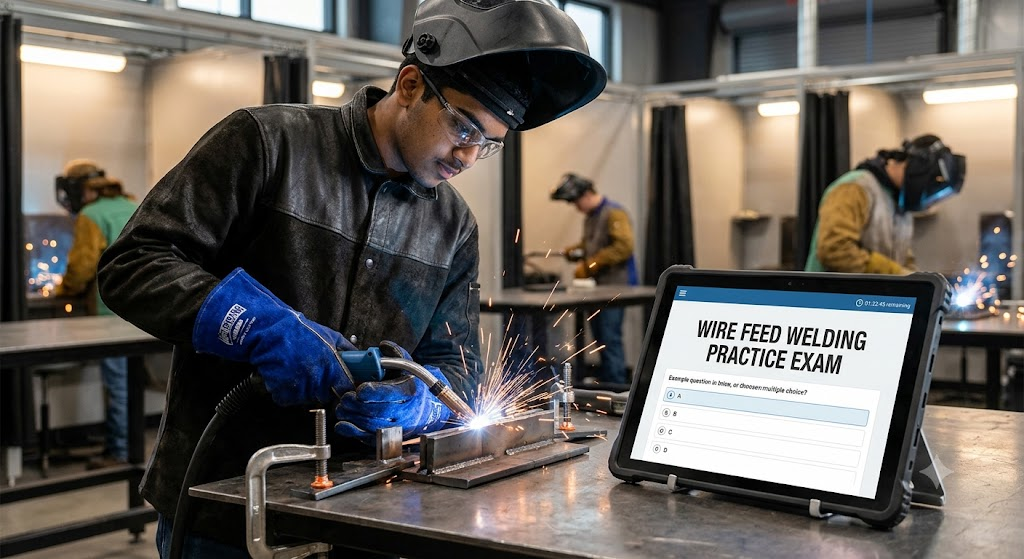
Additional Information
What the Course Entails and Exam Details
This practice exam covers the essential knowledge base required for wire feed processes. While preparatory courses vary, the exam focuses on standard industry topics, including safety protocols specific to wire feed welding, proper equipment setup, and troubleshooting machine parameters. Candidates are expected to understand metallurgy basics, electrode wire classification systems, shielding gas selection, joint design, and blueprint reading. The exam validates a student's ability to interpret a Welding Procedure Specification (WPS) and recognize common weld defects and their remedies.
What to Expect in the Final Exam
When taking an official certification exam, you should expect a two-part evaluation process. The knowledge portion (which this practice test simulates) is usually a closed-book, multiple-choice assessment that must be completed within a strict time limit (e.g., 2 hours). It tests theoretical understanding and code interpretation. Following the knowledge test, you must pass a supervised practical performance qualification. In the practical portion, you will be required to produce specific weld coupons (such as fillet or groove welds) in specific positions (e.g., 2G, 3G, 4G) which are then subjected to visual inspection and destructive (bend) or non-destructive (X-ray) testing. Passing scores are based on meeting strict acceptance criteria.
How to Study and Exam Centers
Successful preparation for a wire feed welding certification requires a balanced approach of vigorous study and physical practice.
How to Study:
Review Standard Texts: Study accredited welding textbooks, specifically focusing on chapters covering GMAW and FCAW technology and safety.
Utilize Practice Exams: Use this Wire Feed Welding Practice Exam repeatedly to familiarize yourself with question formats and identify knowledge gaps.
Master the WPS: Practice reading and interpreting different Welding Procedure Specifications.
Log Booth Time: There is no substitute for physical practice; spend significant hours perfecting your technique and consistency on various joint configurations and material thicknesses.
Exam Centers:
To take an official certification exam, you will not typically use standard testing centers like Pearson VUE. Instead, you must locate an authorized testing facility. These are often:
AWS Accredited Testing Facilities (ATFs): Authorized locations certified by the American Welding Society.
Community Colleges and Technical Schools: Many vocational schools are licensed to administer code certification testing.
Private Welding Academies: Specialized training centers often host qualification days.
Job Opportunities from the Course
Earning a wire feed welding certification validates your proficiency and opens doors across numerous industries. Common career paths include:
MIG/FCAW Welder
Structural Steel Welder
Manufacturing Welder (Automotive, Heavy Equipment, Aerospace)
Fabricator
Pipefitter / Pipe Welder (Supporting Structures)
Shipbuilder
Maintenance and Repair Welder
Welding Inspector (With additional experience and certification)
Robotic Welding Operator
Finally, here is a professional image generated to support your study guide article, visually representing the connection between technical study and practical skill application.
Frequently Asked Questions
Reviews
5.0
Based on 0 reviews
Leave a Review
No reviews yet. Be the first to review!