
Wisconsin Commercial Pesticide Applicator Practice Test
$69.00
- Buy to unlock unlimited access to all Quiz questions and Answers in this Quiz.
- After purchase you can print a PDF of the whole quiz at any point. The PDF will contain the questions and the correct answers.
About this Exam
The Wisconsin Commercial Pesticide Applicator certification is a mandatory credential for individuals who apply pesticides for hire, on a custom basis, or as an integral part of their job responsibilities within the state. This comprehensive program, overseen by the Wisconsin Department of Agriculture, Trade and Consumer Protection (WDATCP), ensures that applicators possess the knowledge and skills necessary to handle and apply pesticides safely, effectively, and in accordance with state and federal regulations. The certification is designed to protect public health, the environment, and agricultural resources. It caters to a wide array of professionals, from agricultural producers and lawn care specialists to structural pest control technicians and public vector control officers, ensuring a standardized level of competency across the industry.
Ready to test your knowledge?
Buy Now to Access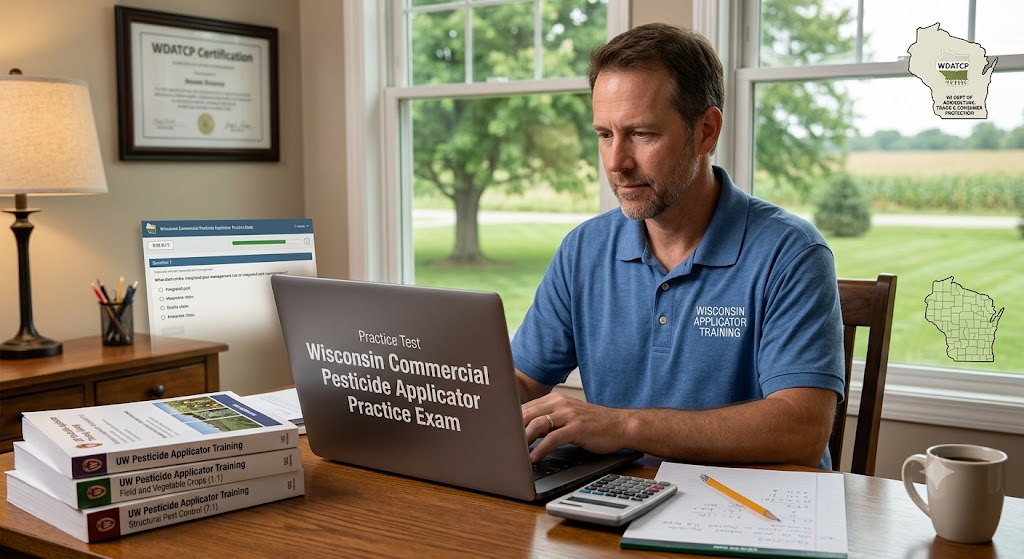
Additional Information
What the Course Entails and Exam Details
To achieve certification, candidates must demonstrate proficiency in both core pesticide safety concepts and specific application categories. The learning material is primarily based on official training manuals provided by the University of Wisconsin-Madison Pesticide Applicator Training (PAT) program. The course curriculum is comprehensive, covering topics such as:
Integrated Pest Management (IPM): Principles and strategies for effective, environmentally responsible pest control.
Pesticide Laws and Regulations: Understanding state (WDATCP) and federal (EPA) pesticide regulations, including the Federal Insecticide, Fungicide, and Rodenticide Act (FIFRA).
Pesticide Safety: Proper handling, storage, transport, disposal, and personal protective equipment (PPE) requirements.
Environmental Protection: Minimizing drift, runoff, and non-target impacts to groundwater and wildlife.
Pesticide Label Comprehension: Interpreting and following all label instructions as the law.
Application Equipment: Calibration, maintenance, and operation of various application devices.
Calculation and Math: Accurately determining application rates, mix dilutions, and area measurements.
The program is dual-structured, requiring a pass in a "Core Exam" focusing on these fundamental principles, and at least one "Category Exam" specific to the applicator's line of work. Over 20 categories are available, including:
Field and Vegetable Crops (1.1)
Fruit Crops (1.2)
Livestock and Poultry (1.3)
Forestry (2.0)
Turf and Landscape (3.0)
Structural Pest Control (7.1)
Aquatic and Mosquito (5.0)
Right-of-Way and Natural Areas (6.0)
What to Expect in the Final Exam
The final certification exams are designed to test practical knowledge and regulatory compliance. Candidates should expect a challenging but fair assessment of their understanding. Key details include:
Format: The exams are entirely multiple-choice, typically featuring questions with three or four answer choices.
Core Exam: Consists of approximately 50 questions, with a 90-minute time limit. A passing score of 70% is required.
Category Exams: Vary slightly but are generally around 70 questions with a 90-minute time limit, and a required passing score of 70%.
Closed Book: All exams are closed-book. You are not permitted to use any training materials or notes during the test.
Allowed Items: You are allowed to use a simple, non-programmable calculator. A number 2 pencil will be provided. Mobile phones and other electronic devices are strictly prohibited and cannot be used as calculators.
Identification: Valid photo ID (e.g., driver's license) and knowledge of your Social Security Number are required for entry.
Results: Results are typically not given immediately at WDATCP test-only sites or after training sessions but are mailed to you within a few weeks. Pearson VUE online proctored exams may provide an informal result at the end, with official results following within days.
How to Study and Exam Centers
Preparation is paramount. The primary resource for all testable material is the official University of Wisconsin Pesticide Applicator Training (PAT) manual for your specific category. Do not rely solely on third-party guides; the official manual is your source of truth.
Actionable Study Strategies:
Obtain Official Manuals: Purchase the required manual from the UW PAT program. This purchase will generate a unique Pesticide Applicator Training (PAT) number, which is necessary to register for the exam.
Read the Manual Thoroughly: Treat it like a textbook. The "Learning Objectives" at the start of each chapter are direct clues to the material that will be on the exam.
Utilize Practice Tests: Engage with realistic practice tests, like those offered here. They will help you identify weak areas, become familiar with the multiple-choice format, and practice time management. Focus on applying the knowledge rather than simple memorization.
Attend Optional Training: The UW PAT program offers valuable in-person review sessions during the winter months (January–April). These are not substitutes for studying the manual but are excellent supplements that highlight key information.
Focus on Calculations: Do not ignore the math and calibration questions. These are common points of failure and require active practice, not just passive reading.
Understand Label Interpretation: A significant portion of questions requires you to analyze sample pesticide labels. Practice finding critical information like PPE requirements, application rates, and re-entry intervals efficiently.
Where and How to Take the Exam:
WDATCP Test-Only Sites: Schedule your exam directly with WDATCP. They operate several designated "test-only" locations throughout Wisconsin (e.g., in Madison, Green Bay, Eau Claire). This option is available year-round and has a nominal fee (currently around $15).
Training Session End: If you choose to attend an optional in-person UW PAT review session, the certification exam is proctored by WDATCP immediately following the training.
Pearson VUE Test Centers: WDATCP partners with Pearson VUE, allowing you to take the exam at any of their over 50 physical testing centers across Wisconsin. This option offers more frequent scheduling and immediate results, but at a higher cost (currently around $45 per exam).
Pearson VUE Online Proctoring: This allows you to take the exam from a private, secure location (like your home or office) via OnVUE. It requires a computer with a webcam and microphone, a reliable internet connection, and a quiet, uninterrupted environment. Be aware of the strict proctoring rules, as violations can lead to immediate invalidation.
Job Opportunities from the Course
A Wisconsin Commercial Pesticide Applicator Certification unlocks diverse and rewarding career paths across several key sectors. Some of the common job titles and career opportunities include:
Commercial Pesticide Applicator: Work for a private company (e.g., crop dusters, custom blenders, landscaping firms) to apply pesticides for multiple clients.
Lawn Care Technician: Specializing in applying fertilizers, herbicides, and pesticides to residential and commercial properties.
Arborist / Tree Care Specialist: Diagnosis and treatment of tree pests and diseases.
Golf Course Superintendent: Responsible for all turf management, including pest control, on a golf course.
Structural Pest Control Technician: Identifying and managing pests like insects, rodents, and termites in and around buildings.
Vector Control Specialist: Working for a public health agency to manage mosquito, tick, and other disease-carrying vector populations.
Right-of-Way Manager: Controlling vegetation along roadsides, power lines, pipelines, and railways for safety and access.
Forestry Technician: Applying herbicides for vegetation management in timber production and natural resource conservation.
Aquatic Pesticide Applicator: Managing invasive aquatic weeds and other pests in lakes, ponds, and waterways.
Mixer & Loader: A specialized certification for individuals who mix, load, and handle pesticides but do not perform the actual applications.
Frequently Asked Questions
Reviews
5.0
Based on 0 reviews
Leave a Review
No reviews yet. Be the first to review!