
Wisconsin Concealed Carry Weapon (CCW) Practice Exam
$69.00
- Buy to unlock unlimited access to all Quiz questions and Answers in this Quiz.
- After purchase you can print a PDF of the whole quiz at any point. The PDF will contain the questions and the correct answers.
About this Exam
Welcome to your essential resource for preparing for the Wisconsin Concealed Carry Weapon (CCW) licensure process.
This guide is designed for responsible Wisconsin residents (and eligible non-residents) who are seeking to obtain their permit to legally carry a concealed weapon within the state.
Understanding the laws, safety protocols, and responsibilities associated with carrying a concealed weapon is paramount. While Wisconsin does not require a standardized statewide written exam for licensure, applicants must provide proof of completed training, often in the form of a specific safety course.
This guide, and associated practice materials, focuses on the core knowledge required to navigate that training successfully and, more importantly, to carry responsibly.
Ready to test your knowledge?
Buy Now to Access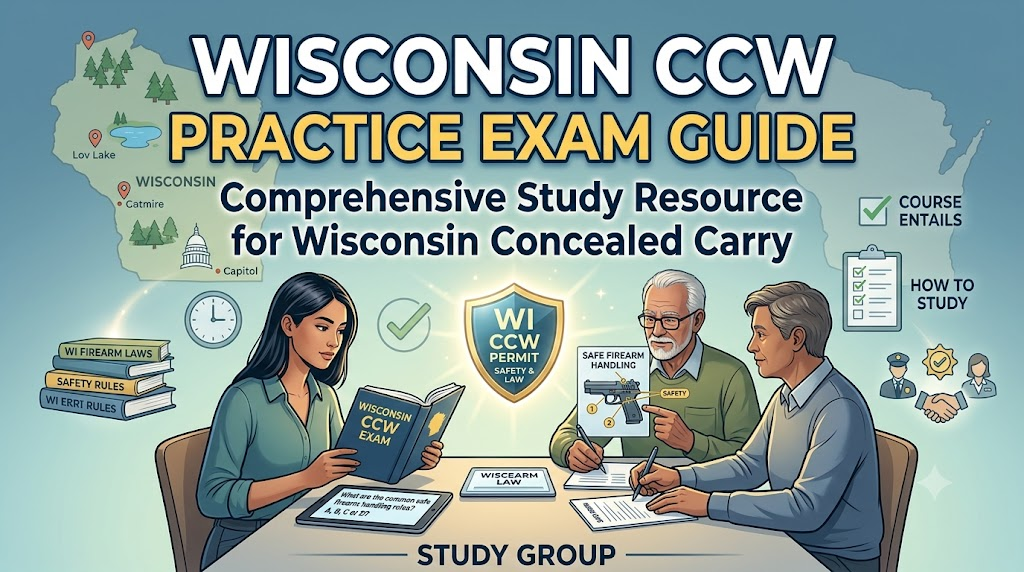
Additional Information
What the Course Entails and Exam Details
To apply for a Wisconsin CCW permit, you must complete a Department of Justice (DOJ) approved firearms safety or training course.
These courses are typically led by certified instructors. The core syllabus generally covers the following critical areas:
Safe Firearm Handling: The four fundamental rules of firearm safety, safe storage practices (especially around minors), and methods for safely loading, unloading, and checking a firearm.
Ammunition and Handgun Knowledge: Understanding different types of handguns (revolvers vs. semi-automatics), how they operate, and the basics of ammunition identification.
Wisconsin CCW Laws: Comprehensive instruction on relevant Wisconsin statutes (e.g., Chapter 175.60), including eligibility requirements, the application process, reciprocity with other states, and renewal procedures.
Use of Force and Self-Defense Law: This is perhaps the most critical section. It covers Wisconsin laws regarding the privilege to use force (including deadly force) in self-defense, defense of others, and defense of property. You will learn about "Duty to Retreat" concepts and "Castle Doctrine" applications in Wisconsin.
Interaction with Law Enforcement: Proper protocols for interacting with police officers while carrying a concealed weapon, including your obligations during a traffic stop.
Prohibited Locations: A detailed review of where you cannot legally carry a concealed weapon in Wisconsin, including federal buildings, schools, police stations, and private properties that have clearly posted "No Weapons" signs.
What to Expect in the Final Exam
While the Wisconsin DOJ does not mandate a specific, state-administered written exam for the CCW permit, most authorized training courses include their own final assessment to verify your understanding.
Here is what you can generally expect:
Format: The most common format is a multiple-choice quiz or short-answer test administered at the end of the required safety class.
Content Focus: The assessment will focus heavily on Wisconsin laws regarding safe handling, prohibited carry locations, and, most importantly, the legal parameters for the use of force in self-defense.
Passing Score: Individual instructors or schools set their own passing requirements, but typically a score of 80% or higher is expected to demonstrate proficiency and receive the course completion certificate.
Practical Component: Some courses may include a non-firing practical assessment (e.g., demonstrating safe loading and unloading procedures) or a live-fire range qualification, although live-fire is not strictly required by Wisconsin law for the standard permit. You should clarify with your specific instructor if a live-fire component is included.
How to Study and Exam Centers
Preparation is key to both passing your course assessment and being a responsible permit holder.
Actionable Study Strategies:
Review Official Materials: Familiarize yourself with the Wisconsin DOJ’s CCW frequently asked questions (FAQ) page and the actual text of Wisconsin Statute 175.60.
Use Practice Exams: Take reputable online Wisconsin CCW practice quizzes to test your knowledge of safety rules and state laws. Focus especially on "who, where, and when" scenarios regarding legal carry.
Take Notes During Your Course: Your certified instructor is your best resource. Engage actively in the required training class, ask questions, and take detailed notes, particularly on legal definitions of self-defense.
How to Find Training (Exam Centers):
In Wisconsin, there are no centralized "testing centers" like Pearson VUE for the CCW permit. Instead, you must locate an authorized training provider.
DOJ-Certified Instructors: The Wisconsin DOJ does not maintain a public list of instructors, but they certify individuals to teach the required curriculum. Look for local firearms instructors or safety schools that explicitly state they offer the "Wisconsin DOJ-Approved CCW Course."
Local Firearms Ranges and Retailers: Most commercial firing ranges and gun stores host CCW classes regularly or can recommend certified instructors.
Technical Colleges: Some Wisconsin technical colleges offer authorized firearms safety courses as part of their continuing education programs.
Job Opportunities from the Course
While many obtain a CCW permit for personal protection, holding this certification—especially when combined with other security training—is highly beneficial or required for several career paths:
Private Security Officer (Armed): Many armed security roles require a valid CCW permit.
Private Investigator: Often requires the ability to carry for personal protection during investigations.
Personal Protection Specialist (Bodyguard): Essential for personnel offering protection details.
Armored Car Guard: Vital for individuals transporting high-value assets.
Bail Enforcement Agent (Bounty Hunter): Requires extensive knowledge of law and safety, often utilizing a CCW permit.
Asset Protection Manager: High-level retail or corporate security roles often prefer candidates with extensive safety certification.
By prioritizing thorough study and choosing a quality training provider, you will be prepared not only to excel in your course assessment but also to exercise your right to carry responsibly and legally in Wisconsin.
Frequently Asked Questions
Reviews
5.0
Based on 0 reviews
Leave a Review
No reviews yet. Be the first to review!