
Wisconsin FORT (Foundations of Reading) Practice Test
$69.00
- Buy to unlock unlimited access to all Quiz questions and Answers in this Quiz.
- After purchase you can print a PDF of the whole quiz at any point. The PDF will contain the questions and the correct answers.
About this Exam
The Wisconsin Foundations of Reading Test (FORT), also known by its test code 890, is a required examination for individuals seeking initial licensure in several crucial education fields within the state of Wisconsin. This state-mandated assessment ensures that educators possess the fundamental knowledge of reading development, instruction, and assessment necessary to support student success.
Specifically, a passing score on the FORT is necessary for those applying for licensure as K–5 elementary teachers, early childhood teachers (birth to grade 3), special education teachers, reading teachers, and reading specialists. It is designed to evaluate a candidate’s pedagogical content knowledge, not general reading ability.
Ready to test your knowledge?
Buy Now to Access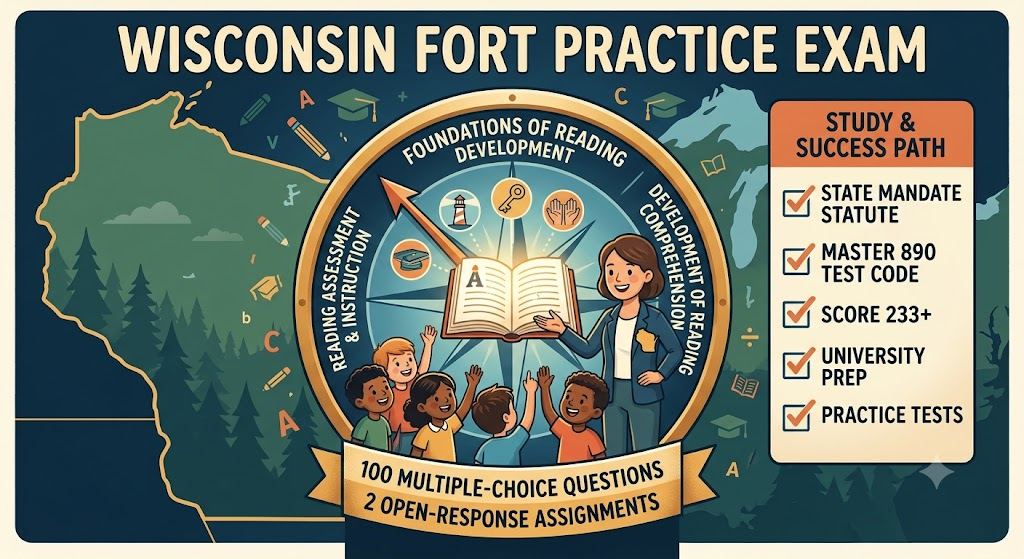
Additional Information
What the Course Entails and Exam Details
Preparing for the Wisconsin FORT means mastering the science of reading. While not a conventional 'course' you sign up for, your teacher preparation program curriculum will align with the FORT's requirements. The test is comprehensive, ensuring you can apply theoretical knowledge to practical classroom scenarios.
The exam content is structured into four main subareas, each contributing to your total score. Effective September 1, 2025, the new test code is 890, though the test framework remains the same. The computer-based test consists of 100 multiple-choice questions and two open-response item assignments.
The subareas and their approximate weightings are as follows:
I. Foundations of Reading Development (35%): Covers language development, phonological and phonemic awareness, concepts of print, the alphabetic principle, phonics, and the development of reading fluency.
II. Development of Reading Comprehension (27%): Focuses on promoting academic language and vocabulary, and analyzing both literary and informational texts.
III. Reading Assessment and Instruction (18%): Evaluates knowledge of best practices for assessing reading development and general reading instruction.
IV. Integration of Knowledge and Understanding (20%): This subarea contains the two open-response questions, which require a developed and organized analysis of reading performance or instruction, integrating concepts from the first three subareas.
What to Expect in the Final Exam
You can expect a rigorous, computer-based testing experience. Your appointment will last approximately 4 hours and 15 minutes, which includes 15 minutes for a tutorial and non-disclosure agreement, leaving you with a solid 4 hours of testing time.
The final exam is composed of two main parts: the multiple-choice section and the open-response section. The 100 multiple-choice questions are distributed across the first three subareas. The two open-response assignments require you to craft well-structured written analysis in response to practical classroom scenarios.
To achieve licensure, you must earn a minimum scaled score of 233 on a scale from 100 to 300. It's crucial to understand that a raw score does not directly translate to a scaled score; the conversion account for the difficulty variation among different versions of the test.
On test day, you must present a valid, government-issued photo ID. If you choose the online-proctored option, you will be required to scan your surroundings with your webcam. The online-proctored format may involve specific time splits for the sections, including an optional break. If you need to retake the exam, a minimum waiting period of 30 days is required. The test fee is $139, valid for one year from registration.
How to Study and Exam Centers
Effective preparation is the key to conquering the Wisconsin FORT. Successful candidates employ multiple strategies:
Official Study Materials: The standard first step is to utilize the preparation materials available on the official NES Wisconsin website (wi.nesinc.com), including the test framework, sample questions, and a full practice test.
Engage with University Resources: Many Wisconsin institutions, such as the UW-System, offer free, self-paced Canvas modules designed specifically for FORT 890 preparation. UW-Milwaukee also offers dedicated test prep courses, both for-credit and non-credit.
Utilize a FORT Practice Test: Take a full, timed practice test early to establish your baseline and identify your weakest areas. Repeat this process as needed. Online platforms like 240 Tutoring, Mometrix, and REA provide targeted practice tests.
Master the Subareas: Allocate study time to specific objectives within each subarea. For example, explicitly study phonemic awareness, phonics rules, morphemic analysis, or a variety of reading comprehension strategies for both fiction and non-fiction.
Focus on Open Response: Practice analyzing student reading assessments and writing organized, instructional recommendations, a critical component of subarea IV.
When you are ready to test, appointments are available year-round, Monday through Saturday, at computer-based testing centers nationwide. You can also opt for online proctoring, taking the exam from your home. The testing vendor provides a 'Locate a Test Center' tool on the official website to find the location that is most convenient for you.
Job Opportunities from the Course
A passing score on the Wisconsin FORT is a non-negotiable step toward securing key educational roles in the state. Achieving this certification directly unlocks licensure for the following positions:
K–5 Elementary Teacher
Early Childhood Teacher (Birth - Grade 3)
Special Education Teacher
Reading Teacher (316 License)
Reading Specialist (17 License)
These specialized certifications significantly enhance your employability within Wisconsin's public, private, and charter school systems, opening a pathway to a rewarding career dedicated to nurturing literacy and a lifelong love of reading in young learners.
Frequently Asked Questions
Reviews
5.0
Based on 0 reviews
Leave a Review
No reviews yet. Be the first to review!