
Wisconsin LE Academy Phase 1 Practice Exam
$69.00
- Buy to unlock unlimited access to all Quiz questions and Answers in this Quiz.
- After purchase you can print a PDF of the whole quiz at any point. The PDF will contain the questions and the correct answers.
About this Exam
The Wisconsin Law Enforcement Academy Phase 1 is the foundational step in the state’s comprehensive 720-hour basic training program for aspiring law enforcement officers. This phase is designed to instill the core knowledge, ethical principles, and basic physical skills necessary to progress to complex, scenario-based training and eventual state certification. It is tailored for pre-service candidates, who generally must possess at least 40 accredited college credits, or individuals already employed by a sponsoring Wisconsin law enforcement agency. Successful completion of Phase 1 is mandatory to advance in the academy.
Ready to test your knowledge?
Buy Now to Access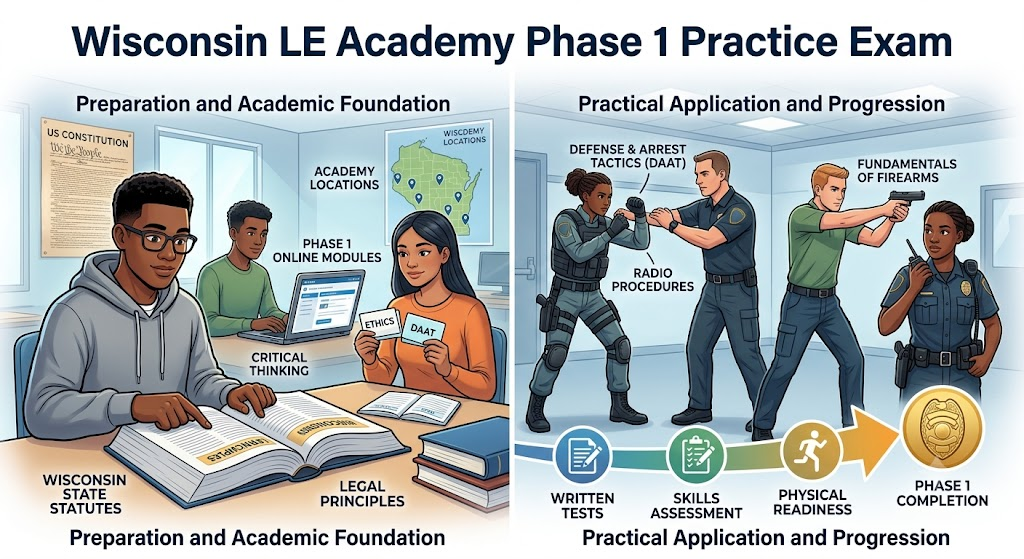
Additional Information
What the Course Entails and Exam Details
This initial phase focuses heavily on classroom learning, policy, and the application of foundational skills. The curriculum is approved by the Wisconsin Law Enforcement Standards Board (LESB) and includes an orientation to the academy and the profession, an overview of the fundamentals of criminal justice, a deep dive into ethics, and essential training in cultural competency and agency policy. Students learn the crucial cognitive skills of critical thinking and decision-making. Practical instruction begins with the Basic Response model (RESPOND), radio procedures, and officer wellness. The core academics cover critical topics like Constitutional Law I, Crimes I, standard interview techniques, and high-quality report writing. Furthermore, students receive an introduction to the physical and technical demands with Fundamentals of Firearms, Vehicle Contacts I, and the fundamentals of Defense and Arrest Tactics (DAAT).
What to Expect in the Final Exam
Progression through Phase 1 is marked by multiple forms of evaluation rather than a single 'final exam.' Candidates must demonstrate proficiency in several distinct areas. There are written assessments, commonly using multiple-choice, true/false, and short-answer questions, that test a student's grasp of state statutes, legal principles, constitutional law, and procedural knowledge. Additionally, students face "skills tests" where they must physically demonstrate proper form and technique in areas such as Defense and Arrest Tactics (DAAT) and basic firearms handling. A candidate must also demonstrate continuous improvement or meet minimum standards in physical readiness, preparing for the final Department of Justice (DOJ) Physical Readiness Test (PRT) required for graduation. All passing scores and standards are set by the Wisconsin LESB, and failing to meet proficiency in any area will result in remediation or dismissal from the academy.
How to Study and Exam Centers
Preparation for Phase 1 demands consistent effort and diverse study methods. Start by organizing all academy materials and focusing heavily on learning the exact wording and elements of key state statutes, as this legal knowledge is non-negotiable. Leverage role-playing with fellow recruits to practice "basic response" (RESPOND) and "vehicle contacts" (I), making your practical skills instinctive. For the written components, form study groups to quiz each other on legal concepts and write sample police reports for critique. Actively use practice question banks specifically for the Wisconsin academy curriculum to become familiar with the logic of the questions. Do not forget physical fitness; train specifically for the DOJ Physical Readiness Test events throughout the phase. All assessments and skills testing take place at the certified regional technical college or public safety training center where the individual is enrolled in the academy. There are no external testing centers, such as Pearson VUE, for this course.
Job Opportunities from the Course
Completion of the entire 720-hour program, beginning with Phase 1, unlocks the following career paths:
Police Officer
Deputy Sheriff
State Patrol Officer
Jailer / Detention Officer
Tribal Police Officer
Conservation Warden
Municipal Court Officer
Security Specialist / Corporate Security
Frequently Asked Questions
Reviews
5.0
Based on 0 reviews
Leave a Review
No reviews yet. Be the first to review!