
Wisconsin Police Academy Phase 3 Practice Test
$69.00
- Buy to unlock unlimited access to all Quiz questions and Answers in this Quiz.
- After purchase you can print a PDF of the whole quiz at any point. The PDF will contain the questions and the correct answers.
About this Exam
The Wisconsin Police Academy Phase 3 Practice Exam is the critical culminating assessment for police recruits in the state of Wisconsin.
This test is designed for recruits who have successfully navigated the foundational knowledge of Phase 1 and the critical physical and tactical skills of Phase 2.
It serves as the bridge between the controlled environment of the academy and the unpredictable nature of real-world policing, ensuring you possess the synthesis of knowledge, judgment, and physical capability required to begin your career as a probationary officer.
Ready to test your knowledge?
Buy Now to Access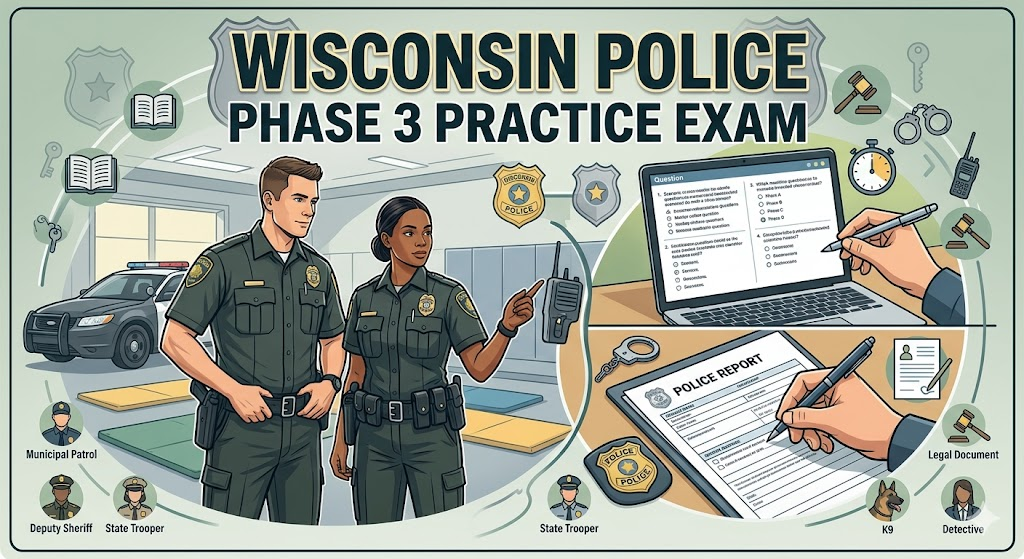
Additional Information
What the Course Entails and Exam Details
Phase 3 is the application phase of the 720-hour Wisconsin Law Enforcement Basic Recruit Training curriculum.
Unlike earlier phases that focus on isolated skills, Phase 3 integrates everything you have learned into complex, scenario-based training.
The core areas covered in Phase 3, which are subsequently validated by the practice exam, include:
Advanced Tactical Response: Synthesizing defensive tactics, firearms proficiency, and use-of-force decision-making.
Emergency Vehicle Operations (EVOC): Demonstrating mastery in high-speed pursuit, precision driving, and vehicle control under stress.
Scenario-Based Scenarios: Handling complex calls such as domestic disputes, active shooters, high-risk traffic stops, and medical emergencies.
Report Writing and Legal Documentation: Creating detailed, legally sound reports based on the scenarios experienced.
Officer Safety and Wellness: Demonstrating continuous situational awareness and managing the mental and physical stress of policing.
What to Expect in the Final Exam
The actual "Final Exam" for Phase 3 is twofold, and the practice exam is designed to mimic both components to prepare you fully.
Component 1: The Scenario-Based Skills Assessment
This is the most critical part of Phase 3. You will not be taking a multiple-choice test in a classroom for this section. Instead, you will be placed in live, dynamic scenarios with role-players. Evaluators will judge your performance based on:
Your ability to assess the scene and identify threats.
Your communication skills (verbal de-escalation and radio usage).
Your application of Wisconsin state laws and department policy.
Your tactical positioning and use-of-force decisions.
Passing Score Requirements: This is typically a Pass/Fail assessment based on critical fail criteria. A single critical error (such as a major safety violation or illegal use of force) can result in failure.
Component 2: The Final Written Comprehensive
Some academies may also include a final written component (like a detailed practice test) to ensure legal knowledge and procedural understanding are still sharp before graduation. This may be administered via an online portal or in a computer lab.
Time Limits: Written sections are timed; scenario evaluations are timed based on the realistic duration of the call.
How to Study and Exam Centers
The best way to "study" for the Phase 3 Practice Exam is through immersion and active synthesis, rather than passive reading.
Actionable Study Strategies:
Form Study Groups for Scenarios: Work with classmates to role-play scenarios outside of class hours. Take turns being the primary officer, the cover officer, and the subject.
Review "Red Line" Rules: Memorize the critical fail criteria for defensive tactics, firearms, and EVOC. Knowing what not to do is just as important as knowing what to do.
Practice Verbal De-escalation scripts: Talk through common scenarios (e.g., a disorderly conduct call) until the appropriate verbal commands become second nature.
Write Practice Reports: After each scenario in class, write a full police report on it, even if not required, and ask an instructor for feedback.
Exam Centers and Locations:
The Phase 3 Practice Exam and the final assessment are administered directly by your specific Wisconsin Police Academy.
There are no external Pearson VUE testing centers for this dynamic assessment. It takes place at your academy’s specialized training facilities, which include tactical training rooms, "Simunition" towns, and the EVOC driving track.
Job Opportunities from the Course
Successfully navigating Phase 3 and the subsequent practice exam validates that you have met the state requirements to become a certified law enforcement officer in Wisconsin. While the academy provides the certification, the course itself unlocks the doors to active duty.
This certification allows you to pursue the following career paths:
Municipal Police Officer (Cities and Villages throughout Wisconsin)
Sheriff's Deputy (Wisconsin County Sheriff's Offices)
University of Wisconsin Police Officer
Wisconsin Department of Natural Resources (DNR) Conservation Warden
Wisconsin State Patrol Trooper
Good luck, recruit. Focus on your training, trust your judgment, and maintain your situational awareness. You are almost there.
Frequently Asked Questions
Reviews
5.0
Based on 0 reviews
Leave a Review
No reviews yet. Be the first to review!