
Wisconsin Rules and Statutes Practice Test.
$69.00
- Buy to unlock unlimited access to all Quiz questions and Answers in this Quiz.
- After purchase you can print a PDF of the whole quiz at any point. The PDF will contain the questions and the correct answers.
About this Exam
The Wisconsin Rules and Statutes Practice Exam is an essential preparatory tool for individuals aiming to obtain professional licensing in the state of Wisconsin, particularly in the real estate and appraisal industries. This exam focuses specifically on the state's unique legal framework, regulatory requirements, and administrative codes. It is designed for aspiring Real Estate Salespeople, Real Estate Brokers, and Appraisers who must demonstrate a comprehensive understanding of Wisconsin law to practice legally and ethically. By simulating the format and content of the state-mandated legal section, this practice test allows candidates to assess their readiness, identify knowledge gaps, and build confidence before taking the final, high-stakes licensing examination. Passing the corresponding section of the actual licensing exam is a non-negotiable step toward launching a compliant and successful career in Wisconsin's regulated professions.
Ready to test your knowledge?
Buy Now to Access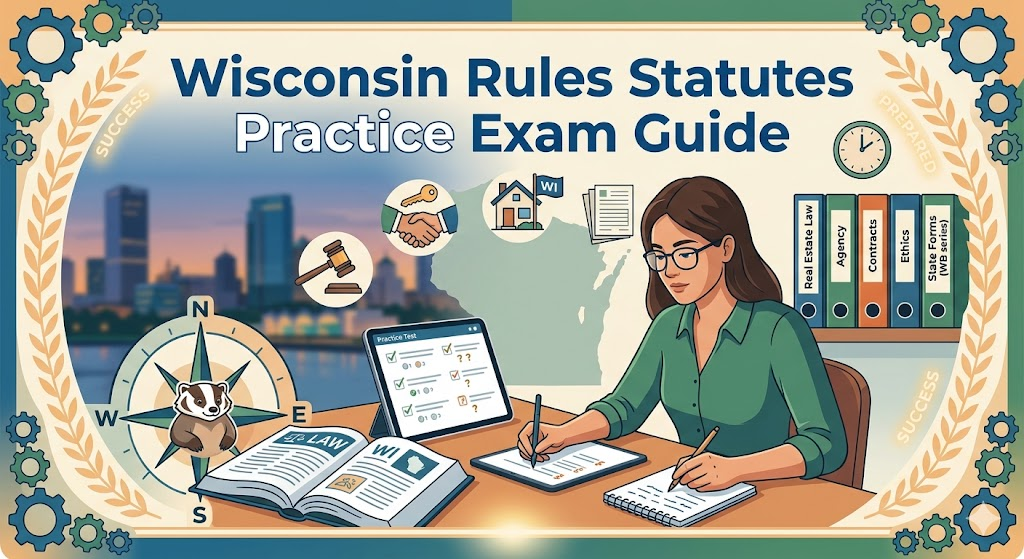
Additional Information
What the Course Entails and Exam Details
This comprehensive practice exam covers all aspects of Wisconsin's administrative rules and statutes relevant to professional practice. Candidates can expect the practice questions to meticulously cover detailed topics.
The core domains of knowledge include a deep dive into the Wisconsin Real Estate Examining Board (REEB) administrative codes (such as REEB 11 through REEB 25) and relevant chapters of the Wisconsin Statutes, including Chapter 452, which governs real estate practice. Specific areas often include:
Licensing Requirements: Detailed rules on applying for, maintaining, renewing, and activating different license types.
Trust Accounts: Strict regulations for managing client funds, including handling earnest money and down payments.
Ethics and Conduct: Understanding state-mandated ethical guidelines, prohibited practices, and definitions of misconduct.
Disclosure obligations: Rules concerning material adverse facts, property condition disclosures, and the required timing for all parties.
Contracts and Agency: Legal requirements for valid contracts, specific definitions of Wisconsin-recognized agency relationships, and related disclosure documents.
Disciplinary Procedures: The structure of the REEB, investigate processes, hearing protocols, and potential penalties for statutory violations.
This is not just a vocabulary test; it tests a candidate’s ability to apply these statutes and administrative rules to real-world scenarios.
What to Expect in the Final Exam
While exact details are set by the official state testing vendor (currently Pearson VUE for Wisconsin), the standard exam is a standardized, computer-based test consisting of multiple-choice questions.
The "Wisconsin Rules and Statutes" component is typically a distinct portion of the broader licensing examination. This state-specific part usually contains between 40 to 60 multiple-choice questions, and you will typically have a specific time limit, such as 60 to 90 minutes, to complete only this state-specific section.
The practice test is designed to strictly replicate this environment, timing, and question structure. The passing score for the actual licensing exam is generally set around 70% to 75% correct responses for this section. It is crucial to check the official Candidate Handbook from the Department of Safety and Professional Services (DSPS) for the most current passing standard.
How to Study and Exam Centers
Preparation for this exam requires focused legal study, rather than general knowledge.
A primary strategy is to access and read the actual text of the Wisconsin Statutes and Administrative Codes referenced above. The official DSPS website provides free, public access to the updated statutes and REEB rules. Practice with simulated exams is one of the most effective techniques. Utilize multiple practice test sessions to become accustomed to the phrasing of regulatory questions. Create detailed flashcards for key definitions, specific legal deadlines (e.g., number of days for earnest money deposit), and different license classifications. Study groups with other licensing candidates can provide diverse perspectives on complex rule applications.
For the actual licensing exam, candidates must register through the state’s authorized testing administrator, Pearson VUE, which operates physical, proctored testing centers across Wisconsin (e.g., Brookfield, Eau Claire, Green Bay, Kenosha, and Madison) and some adjacent states. There is no official center specifically for practice exams; they are typically taken through online educational portals, private real estate schools, and authorized pre-licensing education providers, allowing for flexible, self-paced review.
Job Opportunities from the Course
Successfully mastering this material and subsequently passing the Wisconsin licensing exam opens the door to a wide range of regulated professions. Key career paths and job titles that require a validated understanding of Wisconsin Rules and Statutes include:
Licensed Real Estate Salesperson: A primary credential for representing buyers and sellers in residential or commercial transactions.
Licensed Real Estate Broker: A higher tier of license allowing for office management, supervision of other agents, and independent practice.
Certified Residential Appraiser: Validated professional authorized to value 1-4 unit residential properties.
Certified General Appraiser: Authorized to appraise all types of real property, including commercial, industrial, and agricultural.
Licensed Appraiser: Entry-level appraisal credential for non-complex residential property valuations.
Real Estate Property Manager (if state license is required by firm): Ensuring compliant operations for rental and investment properties.
Mortgage Loan Originator (some overlap, but distinct license): While requiring NMLS training, understanding real estate statutes is beneficial.
These professions are legal requirements for practice and are crucial for employment in real estate firms, appraisal companies, banks, and corporate real estate departments throughout Wisconsin.
Frequently Asked Questions
Reviews
5.0
Based on 0 reviews
Leave a Review
No reviews yet. Be the first to review!