
WMD/Terrorism Awareness for Emergency Responders AWR-160-W Practice Exam
$69.00
- Buy to unlock unlimited access to all Quiz questions and Answers in this Quiz.
- After purchase you can print a PDF of the whole quiz at any point. The PDF will contain the questions and the correct answers.
About this Exam
The AWR-160-W WMD/Terrorism Awareness for Emergency Responders course is an essential foundational training module designed to provide a comprehensive awareness-level understanding of the threats posed by terrorism and Weapons of Mass Destruction (WMD). This training ensures that emergency responders can identify and respond safely to incidents involving Chemical, Biological, Radiological, Nuclear, and High-Yield Explosive (CBRNE) hazards.
This certification is specifically tailored for all personnel who might be among the first to arrive on the scene of a potentially high-consequence event. Its primary focus is on recognition, personal protection, notification, and isolation procedures. This course meets the fundamental requirements of NFPA 472 and NFPA 1072 for Hazardous Materials/WMD Awareness Level personnel.
Ready to test your knowledge?
Buy Now to Access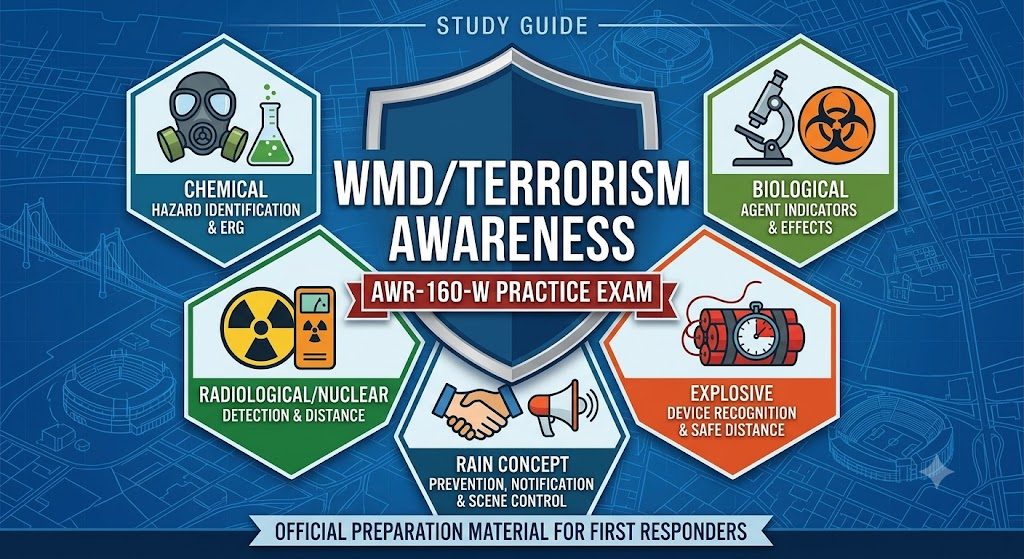
Additional Information
What the Course Entails and Exam Details
The AWR-160-W curriculum is structured around an "all-hazards" approach, equipping students with a universal framework for identifying various catastrophic threats. The core topics, or competencies, that participants must master include:
Introduction to WMD Terrorism Awareness: Understanding the context, history, and motivations behind terrorist attacks, as well as the unique challenges responders face.
Recognition and Identification of CBRNE Hazards: Learning to distinguish the unique characteristics, indicators, and potential delivery methods of different agent categories:
Chemical Agents: Recognizing toxic industrial chemicals (TICs) and militarized chemical warfare agents, including nerve, blister, blood, and choking agents.
Biological Agents: Understanding the different classes of pathogens (bacteria, viruses, toxins) and their modes of transmission.
Radiological Materials and Nuclear Weapons: Learning about the types of radiation, the distinction between a 'dirty bomb' (RDD) and a nuclear weapon, and the unique health risks.
Explosive Devices: Recognizing conventional explosives, improvised explosive devices (IEDs), and the signs of a potential explosive attack.
The Emergency Response Guidebook (ERG): Gaining mastery over utilizing the current DOT ERG to quickly identify hazard classes and determine initial isolation and protective action distances.
Protective Actions and Scene Control: Implementing critical first-responder duties, including recognizing the need for personal protective equipment (PPE), establishing crime scene integrity, isolating the area, and making essential notifications.
What to Expect in the Final Exam
The AWR-160-W final exam is a comprehensive assessment that validates your mastery of the awareness-level competencies detailed above. This test is designed to measure your ability to apply core concepts in a standardized, knowledge-based format.
Exam Format: The test is entirely multiple-choice. It focuses on your ability to recall definitions, identify indicators, and apply the ERG to hypothetical response scenarios. There are no practical, hands-on, or essay components for this awareness-level certification.
Passing Score Requirements: To successfully complete the course and receive your certificate, you must achieve a score of 70% or higher on the final comprehensive post-test.
Number of Attempts: Recognizing the complexity of the material, participants are generally allowed up to 5 attempts to pass the final exam within the course enrollment period.
Time Limits: While the course itself is often described as an 8-hour module, the final post-test usually does not have a strict, independent time limit, allowing you to carefully read and consider each question. However, individual course providers (like TEEX or your state's LMS) may impose their own completion deadlines.
Specific Rules: All modules and quizzes within the course must be completed sequentially before access to the final exam is granted. A non-graded pre-test is often required before the first module.
How to Study and Exam Centers
As an awareness-level course, the AWR-160-W exam focuses heavily on recognition and knowledge retrieval. Your study strategy should prioritize understanding definitions and mastering the use of the ERG.
Actionable Study Strategies:
Thorough Module Review: Do not simply skip to the quizzes. Read every page of the course content. Note unique indicators (e.g., 'the smell of freshly cut hay' for phosgene) for specific agents.
Create Custom Flashcards: Build digital (e.g., Anki, Quizlet) or physical flashcards for definitions, different CBRNE hazard classes, signs/symptoms of exposure, and the structure of the ERG.
ERG Drills: Practice scenario-based ERG lookups. If an initial dispatch says "White plume from a single derailed tank car, UN 1017," can you find the material, isolation distance, and protective action zones in under two minutes?
Take Practice Exams: Utilize authorized practice exams to identify knowledge gaps and get comfortable with the wording of the multiple-choice questions.
Exam Centers and How to Take the Test:
Main Delivery Method: The AWR-160-W is predominantly offered as a web-based, self-paced course. You do not need to visit a physical Pearson VUE center for this particular exam.
Official Providers: The course is developed and often delivered through authorized National Domestic Preparedness Consortium (NDPC) members, such as the Texas A&M Engineering Extension Service (TEEX).
Registration Process: You must first create a FEMA Student Identification (SID) number (https://cdp.dhs.gov/femasid/) to register. Access to the course and exam is then typically gained through the official portal of an authorized provider or your specific State Administrative Agency (SAA) learning management system.
Job Opportunities from the Course
The AWR-160-W certification is widely regarded as a foundational requirement—a "checkbox" of competence—for nearly all personnel within the emergency response framework. While it is rarely a standalone qualification for a promotion, it is a crucial prerequisite that validates your essential readiness to function safely in the modern threat environment.
This certification is essential for, and unlocks career paths within, the following fields:
Fire Service Personnel: (Volunteer and career firefighters, engineers, officers)
Emergency Medical Services (EMS): (EMTs, paramedics, first responders)
Law Enforcement Officers: (Patrol, specialized units, campus police, security)
Emergency Management Professionals: (Planners, coordinators, operations center staff)
Hazardous Materials (HazMat) Responders: (Entry-level team members)
Public Health and Medical Responders: (Hospital ER staff, public health investigators)
Public Works and Infrastructure Personnel: (Water treatment, transportation, utility workers)
Private Security Personnel: (Critical infrastructure, event security, corporate safety)
Frequently Asked Questions
Reviews
5.0
Based on 0 reviews
Leave a Review
No reviews yet. Be the first to review!