
WOBC-B Phase 2 Practice Exam
$69.00
- Buy to unlock unlimited access to all Quiz questions and Answers in this Quiz.
- After purchase you can print a PDF of the whole quiz at any point. The PDF will contain the questions and the correct answers.
About this Exam
The WOBC-B Phase 2 is a crucial, branch-specific phase of the Army Warrant Officer Basic Course (WOBC).
It is designed for newly appointed Warrant Officers (WO1) across various technical specialties to build upon the foundational leadership and common-core skills developed in Phase 1.
This phase shifts the focus from general soldiering and leadership to the technical and tactical competence required to be a subject matter expert and advisor in their designated Military Occupational Specialty (MOS).
Success in Phase 2 certifies that the Warrant Officer is prepared to lead and manage functional elements and provide expert counsel to commanders in their field.
Ready to test your knowledge?
Buy Now to Access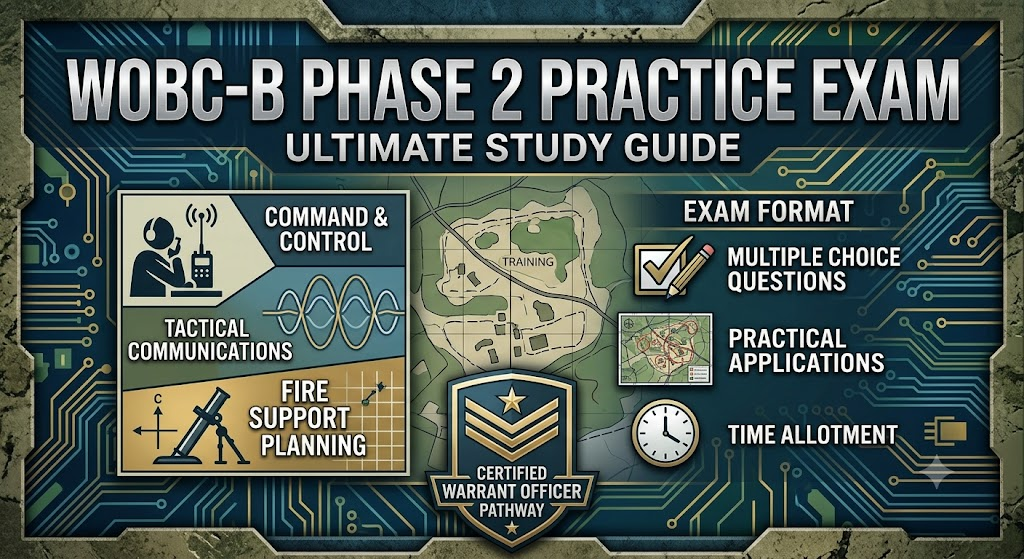
Additional Information
What the Course Entails and Exam Details
WOBC-B Phase 2 content is highly MOS-specific. The "B" signifies the beginning of branch technical training.
While the exact syllabus varies, it generally includes core topics and skills such as:
Branch-Specific Doctrine: Deep study of the Army doctrine and operations relevant to their branch (e.g., Signal, Quartermaster, Ordnance, Adjutant General).
Advanced Technical Skills: Mastery of the technical systems, equipment, and processes central to their specific MOS.
Tactical Integration: Learning how their technical function integrates with and supports ground, air, or combined arms operations.
Property and Resource Management: The principles of accountability and maintenance for specialized equipment within their purview.
Unit-Level Training: Designing and conducting training for enlisted soldiers and NCOs in their specialized field.
What to Expect in the Final Exam
The final assessment for WOBC-B Phase 2 is robust and comprehensive. It is not just a single written exam but a multi-faceted evaluation:
Written Examinations: Standard multiple-choice and scenario-based tests will measure depth of theoretical knowledge of doctrine, technical manuals, and operational procedures.
Hands-on Performance Evaluations: This is a key component. Candidates must demonstrate proficiency in real-world technical tasks, from troubleshooting complex systems to generating operational plans or administrative reports, using actual or simulated equipment.
Situational Training Exercises (STX): These practical exercises require the candidate to apply their technical skills under tactical conditions, mimicking typical field environments and operational pressures.
Passing Requirements: While specific thresholds vary by branch, a minimum passing score of 80% on all written exams and a classification of 'Go' or 'Pass' on all hands-on and practical evaluations is common.
Time Limits: Assessments are often timed to test proficiency and decision-making under stress. The exact time for written exams can range from one to three hours, while practical exercises can span several days.
How to Study and Exam Centers
Effective preparation requires a blend of technical study and practical practice:
Deep Dive into References: Study and restudy your branch-specific Field Manuals (FMs), Technical Manuals (TMs), Army Regulations (ARs), and Department of the Army Pamphlets (DA PAMs).
MOS-Specific Flashcards: Create or utilize digital or physical flashcards for complex acronyms, technical specifications, and key procedural steps.
Peer-to-Peer Teaching: Study groups are invaluable. Explaining complex technical concepts or tactical integrations to your peers is one of the best ways to solidify your own understanding.
Simulation and Practical Time: Maximize any scheduled time in simulators, tech labs, or during practical field training. Hands-on muscle memory is essential for the practical evaluations.
Taking the Exam: The majority of WOBC-B Phase 2 testing is conducted in-resident at the respective branch school or authorized physical testing centers at your stationing, such as the U.S. Army Warrant Officer Career College or specialized branch centers (e.g., Fort Eisenhower for Signal, Fort Gregg-Adams for Quartermaster). Some written, theoretical modules may be administered through official online portals, but practicals are strictly hands-on and in-person.
Job Opportunities from the Course
Successfully completing WOBC-B Phase 2 is the gateway to a challenging and rewarding career as a recognized technical expert. This certification, coupled with continued professional development, unlocks leadership roles in dozens of highly specialized fields. Key job titles and career paths include:
Information Systems Technician (MOS 255A)
Property Book Officer (MOS 920A)
Human Resources Technician (MOS 420A)
Electronic Systems Maintenance Warrant Officer (MOS 948D)
Automotive Maintenance Warrant Officer (MOS 915A)
Cyber Warfare Technician (MOS 170A)
Aviation Maintenance Technician (MOS 151A)
Food Service Technician (MOS 923A)
Signal Systems Support Technician (MOS 255N)
Legal Administrator (MOS 270A)
This comprehensive study guide is your first step toward mastering the technical skills and tactical understanding needed to excel in your field and faithfully serve as a leader in the U.S. Army. Study hard, practice deliberately, and move forward with confidence.
Frequently Asked Questions
Reviews
5.0
Based on 0 reviews
Leave a Review
No reviews yet. Be the first to review!