
WOBC Military Decision-Making Process (MDMP) Practice Test
$69.00
- Buy to unlock unlimited access to all Quiz questions and Answers in this Quiz.
- After purchase you can print a PDF of the whole quiz at any point. The PDF will contain the questions and the correct answers.
About this Exam
Welcome to your essential resource for mastering the Warrant Officer Basic Course (WOBC) Military Decision-Making Process (MDMP) assessment. This study guide and practice environment are specifically designed for newly appointed United States Army Warrant Officers attending their respective branch WOBC.
The WOBC MDMP Practice Test serves as a critical checkpoint in your progression from a technical expert to a tactical and operational leader. It evaluates your understanding of the Army’s core problem-solving methodology used by staffs to visualize the battlespace, organize forces, and execute complex missions. This is not just an exam; it is a validation of your readiness to function effectively as a critical staff member in any operational environment.
Ready to test your knowledge?
Buy Now to Access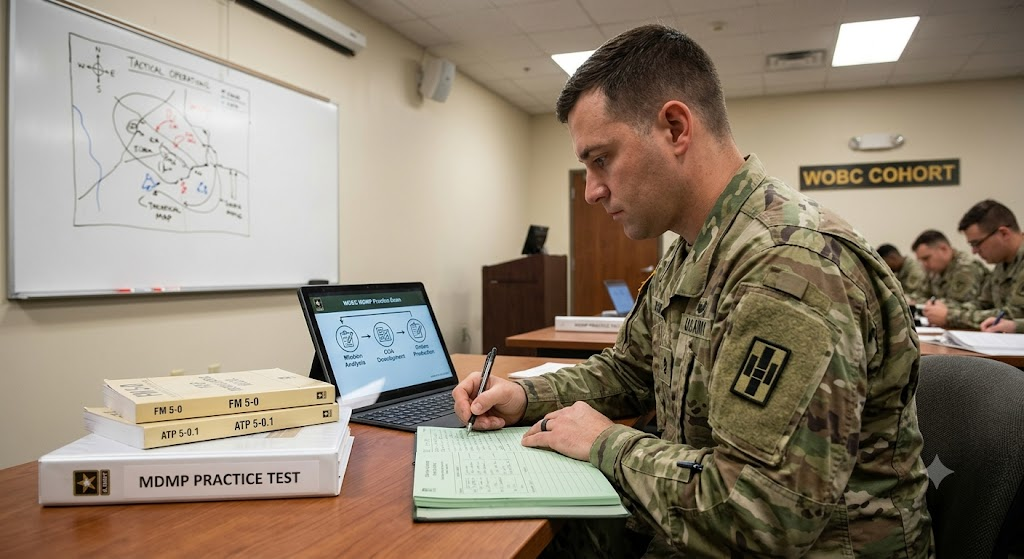
Additional Information
What the Course Entails and Exam Details
This course module and the resulting practice exam focus heavily on the seven distinct steps of the Military Decision-Making Process. You are required to understand the inputs, processes, and outputs of each phase.
The core syllabus covers deep dives into these specific areas:
Step 1: Receipt of Mission. Understanding how a commander initiates the planning process upon receiving a new requirement.
Step 2: Mission Analysis. This is the critical foundation of the MDMP. You must understand how to analyze the higher headquarters’ plan, determine specified, implied, and essential tasks, and identify constraints.
Step 3: Course of Action (COA) Development. Learning how to synthesize information from mission analysis into distinct, feasible tactical options.
Step 4: COA Analysis (War-Gaming). Mastering the rules and steps of war-gaming to identify the strengths and weaknesses of each COA.
Step 5: COA Comparison. Using objective criteria to compare the developed COAs against each other.
Step 6: COA Approval. Knowing how to properly present a decision briefing to a commander for approval.
Step 7: Orders Production. The final culmination where the selected COA is translated into a comprehensive Operation Order (OPORD).
What to Expect in the Final Exam
When sitting for the actual WOBC MDMP examination, you should anticipate a comprehensive testing format that challenges both your conceptual knowledge and your practical application skills.
Exam Format: The assessment is typically divided into two major components. The first section is a rigorous multiple-choice test focusing on definition, terms, and distinct step interactions. The second, and often more demanding component, is a scenario-based practical application. You will be given a mission and fragmentary information and required to generate valid outputs for key steps, such as a Mission Analysis Brief or a Course of Action sketch.
Time Limit: The final exam is heavily time-constrained to simulate operational stress. You can expect a total testing window ranging from four to six hours, depending on the complexity of the scenario and specific schoolhouse requirements. Time management is crucial.
Passing Score: A passing grade is typically 80% or higher. Military personnel know that excellence, not just compliance, is expected at the WOBC level.
Rules: This is often an "open resource" but "no assistance" exam. This means you may use FM 5-0 or ATP 5-0.1 (Army Planning and Orders Production), but you must complete all work independently. Failure to manage your time while searching manuals is a common cause of failure.
How to Study and Exam Centers
Preparation for the MDMP exam requires a blend of dynamic study and repetitive practice.
Actionable Study Strategies:
Master FM 5-0 (or current equivalent ATP): This manual is your primary "textbook." You must not only read it but also understand where every template and step definition is located. Create tabs for essential charts, such as the steps of Mission Analysis.
Practice Mission Analysis: Since this is the foundation of the MDMP, focus heavily here. Practice taking a generic Warning Order (WARNORD) and rapidly identifying essential tasks, key terrain, and constraints.
Engage in Group Study: The MDMP is a team process. Studying with peers allows you to run "mock war-games" and practice briefing COA options to one another, which is essential for the practical application portion.
Exam Center Locations:
The WOBC MDMP examination is not offered through commercial testing centers like Pearson VUE. It is administered directly at your respective US Army Branch Centers of Excellence (CoE) as part of the WOBC resident curriculum. Examples include the Signal School at Fort Eisenhower, the CASCOM Quartermaster or Ordnance Schools at Fort Gregg-Adams, or the Aviation Center of Excellence at Fort Novosel. While preparatory materials may be available online via Army portals like the Army Learning Management System (ALMS), the credit-bearing final exam occurs in the physical classroom.
Job Opportunities from the Course
Successfully navigating the WOBC MDMP Practice Test and passing the final exam is a pivotal achievement in a Warrant Officer's career. While it does not unlock a specific civilian job immediately, it fundamentally enables advancement into key staff roles within the Army structure.
Graduation from WOBC, of which this exam is a major hurdle, solidifies your role and advancement potential within these key paths:
Battalion and Brigade Staff Officer: You will be qualified to serve as a primary technical advisor in your specific warfighting function on a battalion or brigade-level staff, actively participating in real-world MDMP.
Specialized Planning Cells: You will be equipped to work within dynamic, specialized planning cells (such as the S3 or G3 operations sections), addressing complex operational challenges for large formations.
Progression to WOAC: Mastery of MDMP at the basic course is prerequisite knowledge required for promotion and attendance at the Warrant Officer Advanced Course (WOAC), unlocking future leadership opportunities as a Chief Warrant Officer 3 (CW3).
Frequently Asked Questions
Reviews
5.0
Based on 0 reviews
Leave a Review
No reviews yet. Be the first to review!