
WOBC Opposing Force (OPFOR) Practice Test
$69.00
- Buy to unlock unlimited access to all Quiz questions and Answers in this Quiz.
- After purchase you can print a PDF of the whole quiz at any point. The PDF will contain the questions and the correct answers.
About this Exam
The Warrant Officer Basic Course (WOBC) Opposing Force (OPFOR) Practice Test is a critical tool for U.S. Army Warrant Officers who are in the early stages of their technical and tactical certification. This specialized exam is designed for newly appointed Warrant Officers—specifically those assigned to branches that heavily interface with tactical operations—to validate their understanding of how a composite, capable enemy force operates. Mastering OPFOR doctrine is not just about learning how "the bad guys" fight; it is fundamental to developing the critical thinking skills necessary to anticipate threat actions, create robust, adaptive training scenarios, and ultimately lead friendly forces to victory in a multi-domain operational environment. For those aspiring to be the technical advisors commanders rely on, this test marks a defining step in professional development.
Ready to test your knowledge?
Buy Now to Access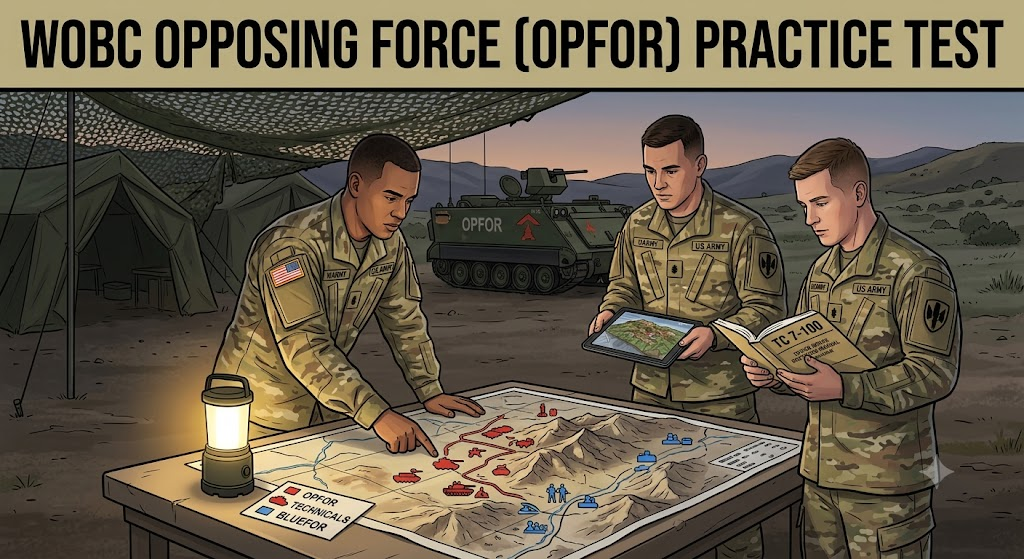
Additional Information
What the Course Entails and Exam Details
The full WOBC curriculum provides comprehensive technical training within a specific Military Occupational Specialty (MOS). Within that broader context, the OPFOR-specific training is often foundational common core material or a specialized module. It moves beyond generic principles and dives deep into specific, doctrine-based threat capabilities. The course material is designed to immerse students in the perspective of the hybrid threat, compelling them to use enemy decision-making frameworks.
The core topics and syllabus covered in this section typically focus on:
OPFOR Doctrinal Frameworks: Deep study of authoritative resources, such as TC 7-100 series (Hybrid Threat) and FM 7-100 series, detailing the organization, equipment, and operational art of contemporary and near-peer adversaries.
Intelligence Preparation of the Battlefield (IPB): Learning to perform IPB from the enemy perspective, including the application of OAKOC (Obstacles, Avenues of approach, Key terrain, Observation and fields of fire, Cover and concealment) to understand how terrain dictates OPFOR movement and deployment.
Tactical Operations: Analysis of OPFOR offensive and defensive tactics, including integrated attacks, area defenses, counter-reconnaissance, and how they employ special purpose forces and irregular threats.
OPFOR Mindset & Decision-Making: Developing the ability to replicate the decision-making process of a threat commander, allowing Warrant Officers to create realistic, adaptive problems during training exercises.
What to Expect in the Final Exam
The final certification exam is a formal evaluation of your ability to apply OPFOR doctrine. It is typically a proctored test administered in a controlled environment.
Exam Format: The test is almost universally a multiple-choice examination. Questions are scenario-based, requiring you to read a situation, analyze a map, or interpret a fragment of an intelligence report to select the correct doctrinal OPFOR response or course of action. It tests application over rote memorization.
Passing Score: Requirements can vary by branch and school, but a standard passing score is usually set at 70% or 80%. Given the technical nature of a Warrant Officer's role, high standards are maintained.
Time Limits: You can expect a strict time limit, which often averages to approximately one minute per question. This is designed to test your proficiency and ability to make rapid, accurate decisions under pressure.
Specific Rules: Standard academic integrity rules apply. The test is usually closed-book, although some iterations may allow for specific, marked doctrinal pamphlets. You must possess a CAC and access the testing platform through secure military networks.
How to Study and Exam Centers
Preparation for this exam requires focused, active learning. Do not rely solely on classroom time.
Active Study Strategies:
Immerse in the Doctrine: Read and re-read the core TC and FM publications. Do not just highlight; create outline notes for key definitions, organizational structures, and tactical principles.
Use Practice Tests: Leverage the resources provided by your school, such as the WOBC Opposing Force (OPFOR) Practice Test. These questions are indicative of the style and difficulty of the final exam. When you miss a question, do not just find the correct answer; find the exact doctrinal reference that explains why the answer is correct.
Scenario-Based Review: Work with fellow students to create your own scenarios. "What would a threat commander do if they encountered a friendly obstacle at this point on the map?" Practice making those decisions rapidly.
Visualize: Use map graphics and correlation of forces (COFM) tables to visualize the "building block" approach of an OPFOR formation and how it relates to terrain and mission.
Exam Centers: The WOBC OPFOR validation is not a generic test available via external portals like Pearson VUE. It is part of official U.S. Army institutional training. The actual testing takes place:
In-Resident: While attending your branch’s official WOBC resident course.
Authorized Distance Learning: Through the Army Learning Management System (ALMS) or specific school portals (like the Virtual OPFOR Academy) when assigned as part of a structured distance-learning phase.
Job Opportunities from the Course
Successfully completing WOBC and validating your OPFOR expertise is not just a course requirement; it is a vital prerequisite for serving in several high-impact roles where technical mastery of the threat is non-negotiable.
This certification is directly relevant to and unlocks career paths in job titles such as:
MOS-Specific Technical Warrant Officer: E.g., All Source Intelligence Technician (350F), Field Artillery Targeting Technician (131A), Mobility Officer (882A), or Cyber Warfare Technician (170D). In these roles, you will advise commanders on threat capabilities and how they impact your warfighting function.
Observer, Coach / Trainer (OC/T) at Combat Training Centers: Replicating the OPFOR and evaluating friendly unit performance against realistic threat scenarios.
G2 / S2 Threat Analyst: Working in an intelligence shop to assess real-world and training threat capabilities.
Tactical Operations Officer / Planner: Integrating threat analysis into friendly operational planning.
Military Instructor: Training the next generation of officers on OPFOR doctrine at professional military education schools.
This certification solidifies your foundation, marking you as a vital asset to any unit operating in today’s complex and contested environments. Study hard and prepare thoroughly.
Frequently Asked Questions
Reviews
5.0
Based on 0 reviews
Leave a Review
No reviews yet. Be the first to review!