
WOBC Sustainment Practice Exam
$69.00
- Buy to unlock unlimited access to all Quiz questions and Answers in this Quiz.
- After purchase you can print a PDF of the whole quiz at any point. The PDF will contain the questions and the correct answers.
About this Exam
The Warrant Officer Basic Course (WOBC) Sustainment track is designed for newly appointed U.S. Army Warrant Officers specializing in logistics branches, including the Quartermaster, Ordnance, and Transportation corps. This certification process is the primary technical training program a new Warrant Officer receives after Warrant Officer Candidate School (WOCS). It aims to certify officers as technically and tactically competent to serve in their designated military occupational specialty (MOS) at the company and battalion levels. Successful completion of this course is a critical milestone, ensuring that these officers can provide expert guidance and technical leadership to commanders, enlisted personnel, and other officers.
Ready to test your knowledge?
Buy Now to Access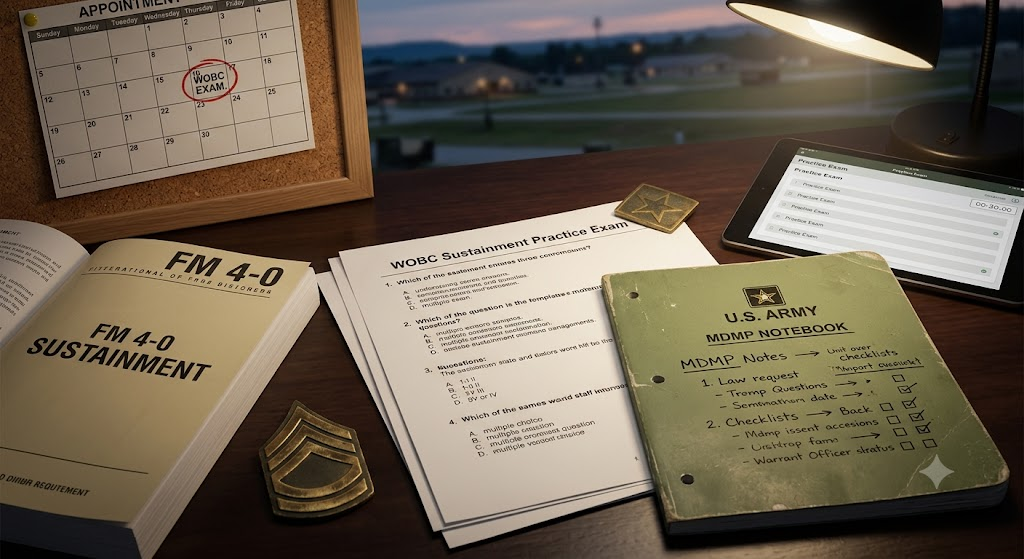
Additional Information
What the Course Entails and Exam Details
The WOBC Sustainment course provides in-depth technical training specific to each logistics branch while integrating common core tactical skills. The curriculum focuses on advanced technical fundamentals, organizational equipment and systems, and advanced diagnostic procedures for their respective fields. For Quartermaster officers, this may include property book operations and supply chain management; for Ordnance, maintenance and munitions operations; and for Transportation, movement control and modal operations. Beyond technical expertise, the course covers the Military Decision-Making Process (MDMP), logistics planning, combined arms operations, and sustainment functions in unified land operations. The ultimate goal is to prepare officers to solve complex problems within their area of expertise and advise command teams effectively. A series of written exams and practical applications are part of the course. The practice exam helps simulate these assessments.
What to Expect in the Final Exam
While the exact structure may vary by specific branch and class, a final comprehensive exam often includes a mix of multiple-choice questions, situational scenarios, and practical technical application. The exam is typically time-limited, putting pressure on students to demonstrate decisive, accurate thinking under stress. A passing score is mandatory for graduation. The multiple-choice sections will likely test knowledge of branch-specific doctrine, regulations, technical procedures, and Army tactical concepts like MDMP. Practical applications may involve using specific logistics information systems or planning a sustainment operation based on a tactical scenario. The practice exam is designed to mirror these challenges, covering key themes such as task identification within MDMP (specified, implied, essential), the application of the 1/3-2/3 planning rule, and branch-specific technical logistics concepts.
How to Study and Exam Centers
Actionable study strategies for the WOBC Sustainment Practice Exam and the final exam are essential. Focus your efforts on mastering the core branch-specific manuals, Army regulations, and the fundamental tactical concepts, especially the MDMP. Understand key planning factors, technical terms (e.g., OAKOC, IPB, maintenance types), and logistics processes. A highly recommended method is to use practice exams repeatedly to simulate the testing environment and identify your weak areas. Create flashcards for critical acronyms, doctrine, and technical procedures. The actual final WOBC exam is taken within the specific Army schoolhouse for your branch, such as Fort Gregg-Adams (formerly Fort Lee) for the Quartermaster and Ordnance branches and Fort Novosel (formerly Fort Rucker) for Aviation. Practice exams can be accessed through your provided course materials, authorized online learning portals, or through the Army's specialized training networks (e.g., CAC-required systems).
Job Opportunities from the Course
Successful completion of the WOBC Sustainment track, culminating in the passing of the final exam and awarding of the technical MOS, unlocks a clear career path to becoming a highly specialized advisor and technical expert. This certification is required for continued service and promotion within the Warrant Officer cohort. Here are some of the primary job opportunities and career paths this unlocks:
Quartermaster Warrant Officer:
Property Book Warrant Officer
Supply Chain Management Warrant Officer
Petroleum and Water Warrant Officer
Ordnance Warrant Officer:
Maintenance Warrant Officer (Ground or Aviation)
Ammunition Warrant Officer
Explosive Ordnance Disposal (EOD) Warrant Officer
Transportation Warrant Officer:
Mobility/Transportation Warrant Officer
Marine Deck/Engineering Warrant Officer
Movement Control Warrant Officer
These roles prepare officers for increasing levels of responsibility, leading to promotion to Chief Warrant Officer 2 (CW2) and beyond, with subsequent professional military education.
Frequently Asked Questions
Reviews
5.0
Based on 0 reviews
Leave a Review
No reviews yet. Be the first to review!