
WOBC Targeting Practice Exam
$69.00
- Buy to unlock unlimited access to all Quiz questions and Answers in this Quiz.
- After purchase you can print a PDF of the whole quiz at any point. The PDF will contain the questions and the correct answers.
About this Exam
The WOBC Targeting Practice Exam is an essential preparatory tool designed specifically for newly appointed U.S. Army Warrant Officers attending their Warrant Officer Basic Course (WOBC) in a Targeting military occupational specialty (MOS), such as 131A Field Artillery Targeting Technician. This practice exam serves as a simulation of the rigorous technical certification assessment that all Warrant Officers must pass at the conclusion of their WOBC to continue serving in their designated MOS. It is engineered to help students build confidence, reduce test anxiety, and achieve mastery of complex targeting doctrine. By providing a realistic testing environment, the WOBC Targeting Practice Exam enables candidates to identify critical knowledge gaps and focus their final study efforts effectively.
Ready to test your knowledge?
Buy Now to Access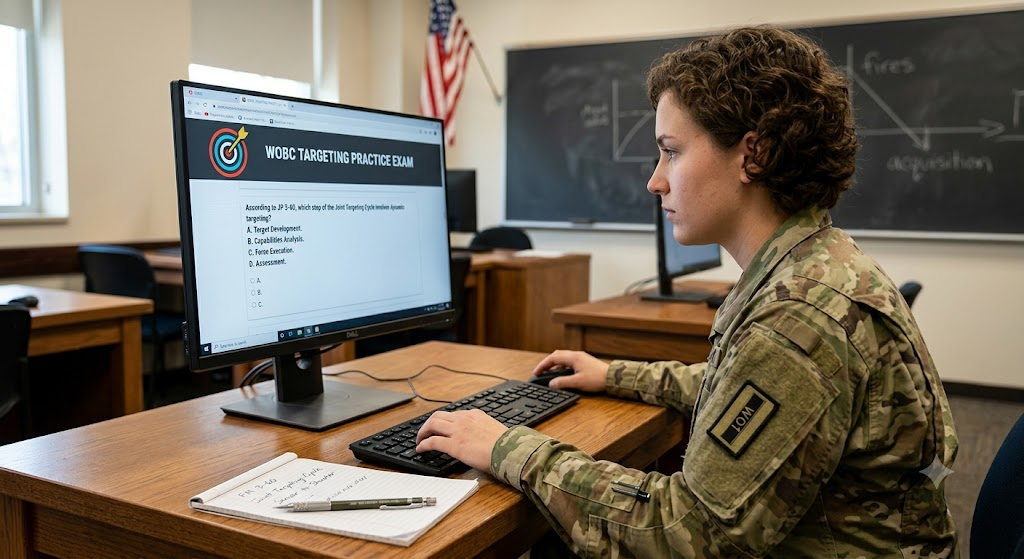
Additional Information
What the Course Entails and Exam Details
The Warrant Officer Basic Course (WOBC) for targeting specialists is a foundational, technical program that transforms newly appointed Warrant Officers into proficient technical and tactical leaders within the Joint Fires environment. The WOBC Targeting Practice Exam encompasses the broad spectrum of the core curriculum. Topics covered include the comprehensive Joint Targeting Cycle, deliberate and dynamic targeting methodologies, and the application of doctrine such as FM 3-60 (The Targeting Process). Candidates must master target acquisition asset employment, synchronization of joint fires, combat assessment, and the technical aspects of various sensing and weapon systems. The practice exam aims to test depth in these areas, ensuring students are prepared for the multifaceted questions of the final exam.
What to Expect in the Final Exam
The final WOBC technical certification exam is a comprehensive assessment that validates a Warrant Officer’s ability to serve effectively in their targeting MOS. Candidates should expect a rigorous, multifaceted examination format that includes a combination of computer-based written components and hands-on, scenario-based practical applications. Written sections often feature multiple-choice, matching, and short-answer questions focusing on doctrinal knowledge and technical computations. Practical application assessments require candidates to demonstrate their ability to apply targeting methodology in real-time or simulated tactical scenarios, such as creating a targeting synchronization matrix or developing a strike package. A high passing score, typically 80% or higher, is required to achieve MOS certification, and strict time limits are enforced for all sections of the exam.
How to Study and Exam Centers
Effective preparation for the WOBC final exam requires a disciplined and strategic study plan, integrated directly with the WOBC curriculum.
Actionable Study Strategies:
Utilize Official Doctrine: Make the Joint and Army Targeting Publications (e.g., JP 3-60, FM 3-60) your primary resource, understanding not just the steps, but the "why" behind the process.
Leverage the Practice Exam: Use the WOBC Targeting Practice Exam iteratively to diagnose your weak points; treat each attempt like the real test.
Form Study Groups: Collaborating with peers is highly beneficial for breaking down complex scenarios and reinforcing technical understanding through teaching.
Scenario-Based Application: Create or seek out additional practical targeting scenarios and work through them step-by-step, applying the doctrinal process.
Exam Centers:
The final WOBC technical certification exam is typically administered internally at the specific schoolhouse where the Warrant Officer Basic Course is conducted. For Field Artillery Targeting Technicians, this is generally at Fort Sill, Oklahoma. Practice exams are usually accessed through official military learning management systems (e.g., Blackboard or Army Learning Management System) provided during the course of instruction.
Job Opportunities from the Course
Successfully graduating from WOBC and passing the technical certification exam unlocks several critical and high-impact career paths for Warrant Officers. Specific job titles and roles include:
Target Acquisition Platoon Leader (responsible for sensors and radar teams).
Counterfire Officer (managing the technical response to hostile fires).
Target/Electronic Warfare (EW) Integrator at the Brigade Combat Team (BCT) level.
Brigade Targeting Officer (responsible for planning and synchronizing brigade-level fires).
Division Targeting Officer (focusing on the targeting process within the division's area of operations).
Field Artillery Intelligence Officer (FAIO) (specializing in the fusion of intel and target acquisition).
Targeting Officer within a Battlefield Coordination Detachment (BCD).
Corps or Echelons Above Corps (EAC) Targeting Officer.
Frequently Asked Questions
Reviews
5.0
Based on 0 reviews
Leave a Review
No reviews yet. Be the first to review!