
Women in Crime Practice Test
$69.00
- Buy to unlock unlimited access to all Quiz questions and Answers in this Quiz.
- After purchase you can print a PDF of the whole quiz at any point. The PDF will contain the questions and the correct answers.
About this Exam
Prepare for a rewarding career focused on the intricate and vital area of gender and justice with the comprehensive "Women in Crime Practice Test." This specialized study guide and accompanying practice exam are meticulously designed for aspiring criminal justice professionals, sociologists, criminologists, and dedicated students looking to deepen their understanding of women’s unique roles within the criminal justice system. Whether you are aiming for roles in law enforcement, legal advocacy, victim services, corrections, or academic research, this practice exam provides a rigorous and realistic simulation to help you assess your knowledge and confidence before attempting relevant certifications or coursework exams.
Explore the historical perspectives of women in crime and gain insight into the specific challenges and contributions women make as offenders, victims, and trailblazing professionals within a complex system. This course and practice exam are invaluable tools for individuals seeking to make a significant impact in a field where critical analysis of gender and power dynamics is increasingly essential. Join a growing number of students and professionals who are utilizing targeted preparation to excel and advocate more effectively.
Ready to test your knowledge?
Buy Now to Access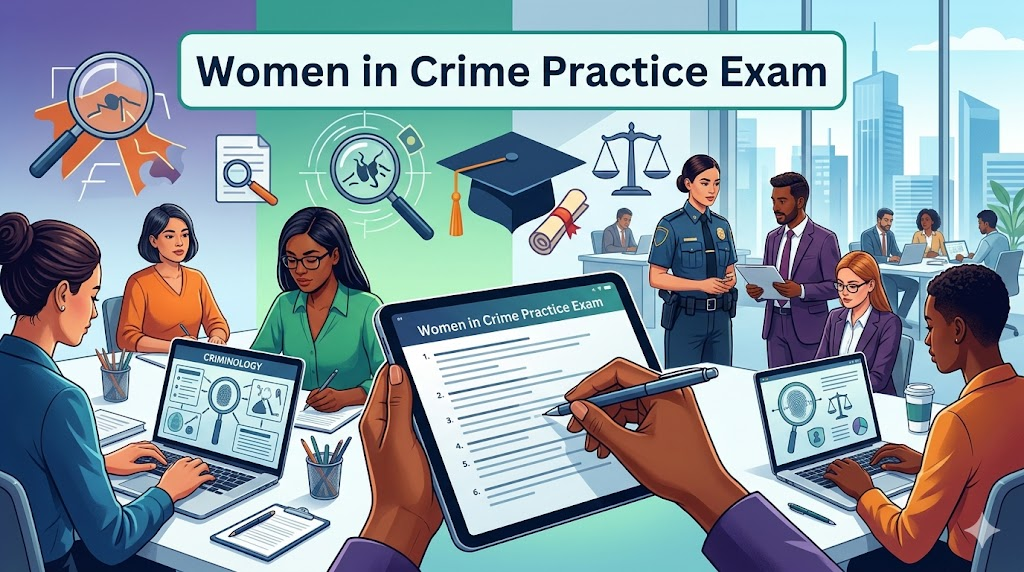
Additional Information
What the Course Entails and Exam Details
A comprehensive course in this field, effectively mirrored in our practice test, delves into diverse aspects of women's experiences and impact within the criminal justice spectrum. Students can expect to study historical and contemporary theories of female criminality, examining motivations, patterns of offending, and the systemic factors influencing women's involvement in crime. The course covers crucial topics such as:
The unique experiences of women as victims of crime and domestic abuse.
The evolution of legal and societal responses to female offenders.
Gender bias and discrimination within police work, courts, and corrections.
The history and impact of women working in various criminal justice professions, from pioneering officers to judges and policymakers.
Feminist criminology and alternative perspectives on justice.
Current research and policy initiatives related to gender and crime.
Through detailed study modules and realistic practice questions, learners will develop critical thinking skills and a profound understanding of these essential issues, preparing them for both academic success and impactful careers.
What to Expect in the Final Exam
The actual final exam you may encounter in a related certification program or course is typically structured as a comprehensive multiple-choice examination. You should expect questions that test not just your recall of facts, but your ability to apply concepts, analyze scenarios, and interpret different perspectives. Here's a general idea of what to prepare for, based on common certification standards:
Format: Multiple-choice questions, which may include case studies or short scenarios to assess deeper understanding.
Time Limit: Typically, you will have a set amount of time (e.g., 90-120 minutes) to complete the exam. Our practice test helps you gauge your pacing.
Passing Score: Most professional certifications require a score of 70% or higher to pass. Aim higher in your preparation to ensure confidence on exam day.
Content Areas: Expect a balanced distribution of questions covering the history, theories, experiences of women as offenders, victims, and professionals, and relevant current events/policy.
Practice under simulated exam conditions is crucial for building the stamina, confidence, and speed necessary for success. Utilize practice tests to identify knowledge gaps and refine your understanding of complex topics.
How to Study and Exam Centers
Effective preparation is key to excelling in any exam. To get the most out of your study time, combine thorough content review with targeted practice. Here’s a strategic approach:
Review Comprehensive Study Materials: Thoroughly read your textbooks, course notes, and explore reputable academic journals and publications related to women and criminal justice.
Utilize Practice Exams: Incorporate realistic practice tests like ours into your study routine regularly. Take them under timed conditions, review your answers diligently (both correct and incorrect), and research the reasoning behind every solution.
Create Flashcards: Make flashcards for key terms, landmark legal cases, significant figures, and core theories to boost your memory and quick recall.
Join Study Groups: Discussing concepts, debating issues, and explaining topics to others can significantly enhance your understanding and memory retention.
Focus on Weak Areas: Dedicate extra study time to sections where you consistently perform less well on practice tests. Don't avoid challenging material.
Regarding exam centers and taking the final exam, procedures can vary. Check with your specific certification body, university, or course provider for detailed information. Many professional certifications utilize established online proctoring services or authorize specific testing centers, such as Pearson VUE or Prometric locations, globally. Some specialized courses or local certifications may require you to take the exam at a designated educational institution or authorized school. Always confirm registration details, ID requirements, and any technical prerequisites well in advance of your desired exam date.
Job Opportunities from the Course
A strong understanding of women in crime issues, validated by education or certification, can open doors to many impactful career paths within and adjacent to the criminal justice system. Consider the following job opportunities:
Victim Advocate / Support Specialist: Empowering and assisting victims of crime, including many women, navigating the legal and emotional challenges of victimization.
Law Enforcement Officer (Specialized Roles): Working as a police officer, detective, or specialized investigator, with particular expertise in handling cases involving female offenders or victims.
Parole / Probation Officer: Supervising and supporting individuals, including many women, through their reintegration into society after involvement in the justice system.
Correctional Officer / Administrator: Ensuring safety and security within correctional facilities, with a focus on understanding and addressing the distinct needs and challenges within women's prisons.
Social Worker (Criminal Justice): Providing counseling, support services, and advocacy within the justice system, helping women and families affected by crime.
Policy Analyst / Researcher: Conducting critical research on gender and crime issues, analyzing policies, and advocating for data-driven reforms within the criminal justice system.
Legal Advocate / Paralegal: Working on legal cases, research, or advocacy related to women's rights, domestic violence, sexual assault, and other gender-based justice issues.
Educator / Trainer: Developing and delivering training or courses on gender and crime topics for academic institutions or professional organizations.
Elevate your career potential in criminal justice and make a difference. Utilize this "Women in Crime Practice Test" as your starting point to mastery and success in this crucial field. Best of luck with your studies!
Frequently Asked Questions
Reviews
5.0
Based on 0 reviews
Leave a Review
No reviews yet. Be the first to review!