
Work TLETS Practice Test
$69.00
- Buy to unlock unlimited access to all Quiz questions and Answers in this Quiz.
- After purchase you can print a PDF of the whole quiz at any point. The PDF will contain the questions and the correct answers.
About this Exam
The Texas Law Enforcement Telecommunications System (TLETS) certification is a vital credential for anyone working within the criminal justice and public safety sectors in Texas.
This certification verifies that an individual possesses the knowledge and ethical understanding required to access, handle, and distribute sensitive law enforcement data.
It is specifically designed for 911 dispatchers, police officers, warrants clerks, and criminal justice administrative personnel who need secure access to state and national databases.
Earning this credential not only ensures compliance with strict government regulations but also empowers professionals to effectively support law enforcement operations in real-time.
Ready to test your knowledge?
Buy Now to Access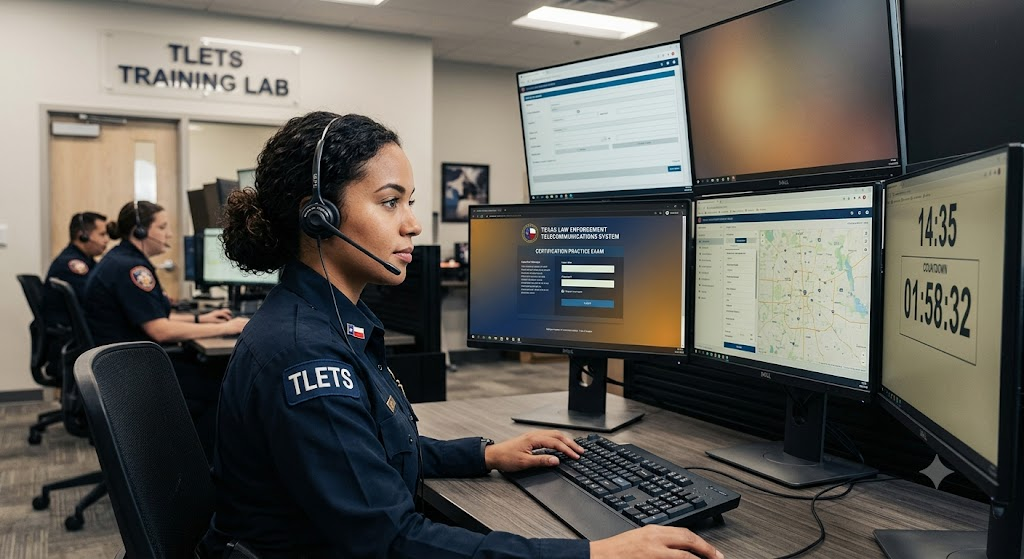
Additional Information
What the Course Entails and Exam Details
The TLETS training course is an intensive program focused on the operational and legal aspects of law enforcement telecommunications.
Students learn how to navigate the intricate network that connects Texas agencies with the National Crime Information Center (NCIC), the Texas Crime Information Center (TCIC), and Nlets.
The syllabus heavily emphasizes the strict protocols surrounding Criminal Justice Information Services (CJIS) security policies.
You will be trained on how to properly execute queries for criminal histories, stolen property, missing persons, and vehicle registrations.
Furthermore, the course covers the critical consequences of mishandling sensitive data, ensuring that every operator understands the legal liabilities associated with unauthorized access.
What to Expect in the Final Exam
The final certification exam is designed to thoroughly evaluate your comprehension of system rules, query formats, and data security procedures.
It is a multiple-choice format test that requires a keen understanding of both broad CJIS policies and specific TLETS operational commands.
To achieve certification, candidates are typically required to score a minimum of 80% on the final assessment.
The exam is timed, usually allowing between one to two hours depending on your specific access level (such as Mobile Access versus Full Access).
While some agencies may allow the use of state-provided training manuals during the test, it is strictly an independent evaluation, meaning collaboration or outside assistance is entirely prohibited.
How to Study and Exam Centers
Success on the TLETS exam requires a strategic and disciplined approach to studying.
Start by thoroughly reading the official Texas Department of Public Safety (DPS) preparation manuals and highlighting key data retention rules.
Creating flashcards for specific transaction codes, query formats, and acronyms is one of the most effective ways to build your memorization skills.
You should also take advantage of online mock exams and practice tests to familiarize yourself with the phrasing of the questions and to improve your time management.
When it comes to taking the test, the exam is exclusively administered through the secure Texas DPS online training portal.
You will typically take the exam at your hiring agency’s physical location under the supervision of a designated training coordinator or an authorized Terminal Agency Coordinator (TAC).
Job Opportunities from the Course
Achieving your TLETS certification opens the door to a variety of stable and rewarding careers within the criminal justice system.
The most common role is a Police Dispatcher or 911 Telecommunicator, where you will use the system daily to relay critical information to responding officers.
It also qualifies you for positions such as a Law Enforcement Records Clerk, responsible for maintaining and updating sensitive local and state files.
You can pursue a role as a Warrants or Evidence Clerk, ensuring that active warrants are accurately entered and validated in the TCIC/NCIC databases.
Additionally, sworn Patrol Officers and State Troopers must hold this certification to run mobile data terminal (MDT) queries from their patrol vehicles.
Frequently Asked Questions
Reviews
5.0
Based on 0 reviews
Leave a Review
No reviews yet. Be the first to review!