
Workplace Readiness Skills CTE Practice Test
$69.00
- Buy to unlock unlimited access to all Quiz questions and Answers in this Quiz.
- After purchase you can print a PDF of the whole quiz at any point. The PDF will contain the questions and the correct answers.
About this Exam
The Workplace Readiness Skills CTE exam is a foundational assessment designed to measure a candidate's mastery of essential "soft skills" and employability skills necessary for success in virtually any professional setting. Unlike technical skill certifications that are specific to one industry, this credential validates the personal qualities, people skills, and professional habits that employers across all sectors value most. This exam is ideal for high school students in Career and Technical Education (CTE) programs, recent graduates, and individuals re-entering the workforce who want to demonstrate to potential employers that they are job-ready from day one. Passing this exam signals that a candidate possesses the maturity, work ethic, and interpersonal abilities required to navigate a modern workplace effectively.
Ready to test your knowledge?
Buy Now to Access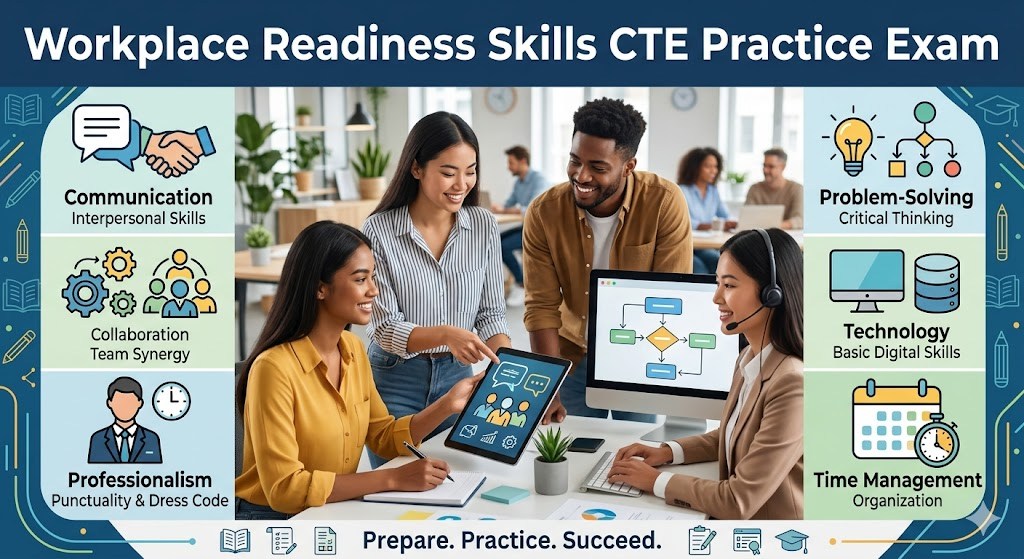
Additional Information
What the Course Entails and Exam Details
This examination evaluates skills rather than extensive theoretical knowledge. The core competencies are generally grouped into three main categories: personal qualities and people skills, professional knowledge, and technological knowledge. Key skills covered include:
Interpersonal Skills: Communication (verbal and written), teamwork, conflict resolution, and customer service.
Professional Knowledge: Work ethic, time management, adaptability, integrity, and safety consciousness.
Technological Knowledge: Basic computer literacy, information literacy (research and verification), and digital citizenship.
Because this is a proficiency-based assessment, there is no standardized "course" that everyone must take, but rather a curriculum of study usually integrated into CTE programs or accessible via independent study modules.
What to Expect in the Final Exam
While the exact structure can vary slightly depending on the specific state board or testing provider, the final exam is typically a standardized, computer-based assessment consisting of 50 to 100 multiple-choice questions.
Candidates are usually given a time limit ranging from 60 to 90 minutes to complete the test. A passing score generally requires achieving a minimum proficiency level, often set around 75-80%. The questions are often scenario-based, asking you how you would react to a common workplace challenge rather than just asking you to define a term. For example, a question might present a situation involving a difficult customer or a conflict with a coworker and ask you to select the most professional course of action.
How to Study and Exam Centers
The best way to prepare for the Workplace Readiness Skills CTE exam is through a combination of content review and practical application.
First, focus your preparation by reviewing the official competencies list provided by your specific CTE program or state department of education. Practice tests are critical; taking sample exams will help you become comfortable with the scenario-based question format and the time constraints. Engage in role-playing exercises for communication, conflict resolution, and customer service scenarios.
The exam is most often administered within Career and Technical Education classrooms, high schools, or dedicated technical centers. These physical centers act as authorized proctoring locations for the test. If you are taking this exam through a specific state or national organization, they may also offer online testing options through secure proctoring portals, allowing you to take the exam from a home or school computer that meets certain technical specifications. Check with your CTE instructor or school guidance counselor for specific details on registration and testing locations near you.
Job Opportunities from the Course
While this is not a technical certification, it is a critical differentiator in entry-level hiring. Possessing this certification can unlock opportunities or provide a decisive advantage in the following job roles across diverse sectors:
Administrative Assistant or Office Support Specialist: Requires strong organization, communication, and basic digital literacy skills.
Customer Service Representative: Directly requires the interpersonal, communication, and conflict resolution skills validated by the exam.
Retail Sales Associate: Companies value reliable employees with good work ethic and customer interaction skills.
Hospitality Staff: Including receptionists, concierge services, or food service roles where teamwork and presentation are key.
Entry-Level Technical Positions (e.g., IT Support, Manufacturing Technician): Even technical jobs require teamwork, safety consciousness, and professional behavior.
Project Coordinator: A foundational step toward management, requiring organization, communication, and reliability.
Frequently Asked Questions
Reviews
5.0
Based on 0 reviews
Leave a Review
No reviews yet. Be the first to review!