
Wound Healing Practice Exam
$69.00
- Buy to unlock unlimited access to all Quiz questions and Answers in this Quiz.
- After purchase you can print a PDF of the whole quiz at any point. The PDF will contain the questions and the correct answers.
About this Exam
Mastering skin integrity and wound healing is a fundamental competency in modern healthcare. The Skin Integrity and Wound Healing practice exam is specifically designed for a wide array of healthcare professionals, including nurses (RNs, LPNs/LVNs), nursing students, physical therapists, occupational therapists, and medical assistants. This test serves as a crucial knowledge check, confirming an individual's understanding of anatomy, physiology, and the critical processes involved in preventing and treating acute and chronic wounds. By completing this practice assessment, you are demonstrating a commitment to proactive patient care and the reduction of healthcare-associated complications, such as pressure injuries.
Ready to test your knowledge?
Buy Now to Access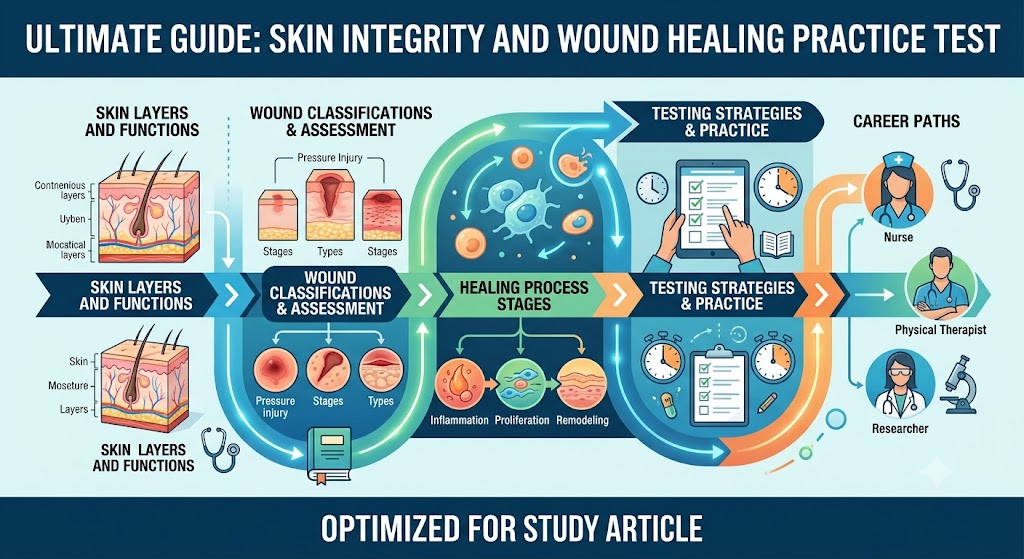
Additional Information
What the Course Entails and Exam Details
This comprehensive assessment evaluates your mastery across several core domains. The syllabus covers the detailed anatomy of the skin and its multifaceted functions as the body's first line of defense. You will be tested on your ability to accurately classify various types of wounds, including surgical incisions, traumatic injuries, and arterial, venous, and diabetic ulcers. A significant portion of the exam focuses on the complex, overlapping stages of physiological wound healing: inflammation, proliferation, and remodeling.
Beyond physiology, you must demonstrate proficiency in wound assessment skills, including measuring wound dimensions, identifying tissue types (e.g., granulation, slough, eschar), and documenting exudate characteristics. The test also dives into evidence-based interventions. This includes understanding advanced wound dressings, topical therapies, and preventive strategies like patient repositioning, pressure redistribution surfaces, and nutritional support.
What to Expect in the Final Exam
While a specific, unified national "Final Exam" may vary depending on the certifying body or institution, most related evaluations follow a computerized, multiple-choice format. You can expect questions tailored to clinical scenarios that require the application, rather than just recall, of your knowledge. These assessments usually enforce a passing score ranging between 75% and 80%, signifying a high standard of core competence. Time limits typically afford roughly 60 to 90 seconds per question, meaning you must be prepared to think critically and efficiently. Some proctored settings may allow review, while others prevent backtracking to completed questions.
How to Study and Exam Centers
Effective preparation is essential for a high-stakes assessment of this nature. The best approach is to simulate the testing environment. Access high-quality practice test databases that provide rationale for both correct and incorrect answers; this is the most critical learning tool. Combine these simulated tests with standard, evidence-based nursing or medical surgical textbooks that detail wound care standards. Utilize visual aids, such as charts of pressure injury staging, to solidify memory. Join focused study groups or forums where you can discuss complex case studies.
Since this knowledge base is tested through various avenues, "Exam Centers" will vary. Many authorized schools, community colleges, and medical training centers host these exams. If you are taking a formalized certification test, such as through the Wound, Ostomy, and Continence Nursing Certification Board (WOCNCB), the exam is typically administered globally at computerized Pearson VUE testing centers. For many practice tests or institutional assessments, a secured online portal is the primary delivery method.
Job Opportunities from the Course
Mastering these skills unlocks significant career opportunities across the clinical spectrum. Here are some of the key job roles that benefit directly from wound care expertise:
Wound Care Nurse (WCN or CWOCN)
Pressure Injury Prevention Specialist
Surgical Nurse
Home Health Nurse
Hospice Nurse
Long-Term Care Facility Manager
Clinical Nurse Educator
Dermatology Nurse
Infection Control Officer
Physical Therapist (specializing in wound debridement)
Clinical Research Coordinator (Wound Care Focus)
Podiatric Medical Assistant
Frequently Asked Questions
Reviews
5.0
Based on 0 reviews
Leave a Review
No reviews yet. Be the first to review!