
Wound Treatment Associate (WTA) Practice Exam
$69.00
- Buy to unlock unlimited access to all Quiz questions and Answers in this Quiz.
- After purchase you can print a PDF of the whole quiz at any point. The PDF will contain the questions and the correct answers.
About this Exam
The Wound Treatment Associate (WTA) program and subsequent certification are critical milestones for healthcare professionals aiming to specialize in a rapidly growing field. This educational pathway is designed specifically for non-specialty nurses, including Licensed Practical Nurses (LPNs), Licensed Vocational Nurses (LVNs), and Registered Nurses (RNs) who want to enhance their bedside wound care skills. It is also an exceptional opportunity for other members of the healthcare team, such as physical therapists and physical therapist assistants, to acquire specialized knowledge.
This course acts as a vital bridge, empowering graduates to provide optimal, evidence-based care for patients with acute and chronic wounds under the direction of a certified Wound, Ostomy, and Continence (WOC) specialty nurse, a WOC advanced practice registered nurse (APRN), or a physician.
Ready to test your knowledge?
Buy Now to Access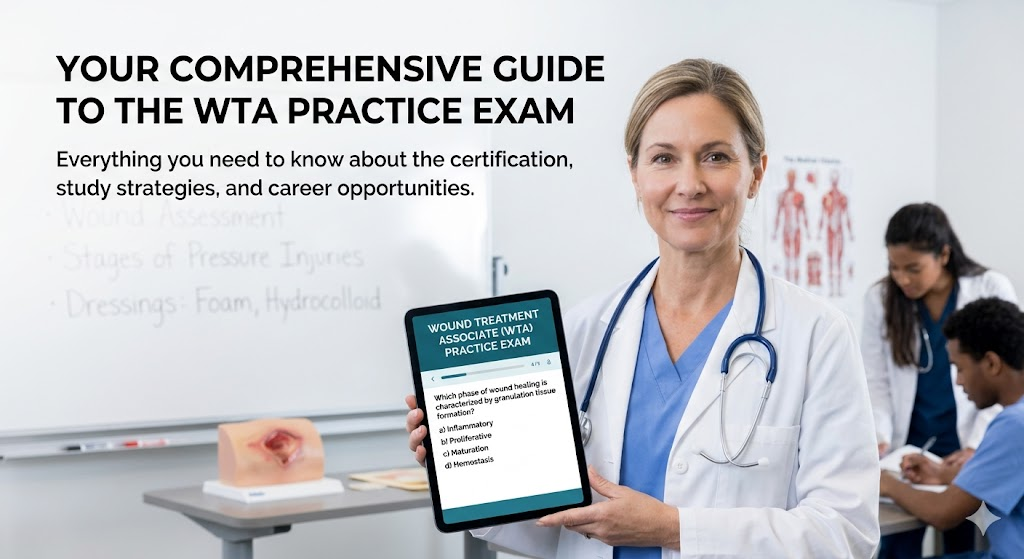
Additional Information
What the Course Entails and Exam Details
The WTA course delivers a comprehensive curriculum that balances theoretical knowledge with practical skills. Candidates will dive deep into the science and practice of modern wound management.
Key areas covered include:
The Anatomy and Physiology of Skin: Understanding the skin's structure and its multi-faceted function as the body's primary barrier.
The Wound Healing Process: Master the complex stages of wound repair, from hemostasis and inflammation to proliferation and maturation.
Wound Assessment and Documentation: Learning how to accurately assess, classify, and document different types of wounds using standardized tools.
Infection Control: Techniques for identifying, preventing, and managing wound infections and biofilms.
Management of Chronic Wounds: Focused training on pressure injuries, venous ulcers, arterial ulcers, and diabetic foot ulcers.
Advanced Dressings and Technologies: Gaining expertise in selecting the appropriate dressing based on wound characteristics and an introduction to advanced therapies.
The goal of the course is to ensure that every associate is prepared to be a collaborative and effective member of a wound care team.
What to Expect in the Final Exam
The Wound Treatment Associate certification exam is designed to rigorously test both the theoretical understanding and practical decision-making skills acquired during the course. Understanding its structure is a key component of a successful study plan.
The final exam is a proctored, standardized test, usually delivered in a computer-based format. While specific details can vary slightly by the certifying body (such as the WOCNCB), you should be prepared for the following:
Exam Format: The test consists of multiple-choice questions. These questions range from direct recall of factual information to complex, scenario-based items that require you to apply your knowledge to solve a patient care dilemma.
Content Distribution: The questions are divided among the core topic areas of the WTA curriculum, with a strong emphasis on assessment and management strategies.
Passing Score: To obtain certification, candidates must achieve a minimum passing score, often set around a scaled score of 70% or higher.
Time Limit: The exam is timed, typically providing 2 to 3 hours to complete all questions. This requires efficient time management and confidence in your wound care knowledge.
How to Study and Exam Centers
Preparation is the cornerstone of passing the WTA exam. Since the material is extensive, a structured approach is essential.
Actionable Study Strategies:
Use a Practice Exam: Engaging with a dedicated Wound Treatment Associate practice exam is one of the single most effective study methods. It familiarizes you with the question format, highlights knowledge gaps, and allows you to practice time management in a simulated environment.
Analyze the Content Outline: Review the official exam content outline provided by the certifying board. Treat this as your master checklist for your study sessions.
Create a Study Schedule: Do not cram. Break the material into manageable sections and create a schedule that spreads your study time over several weeks.
Join a Study Group: Collaborating with peers can help clarify difficult concepts, provide mutual motivation, and offer diverse perspectives on patient care scenarios.
Where to Take the Exam: The WTA certification exam is typically taken through authorized, secure, physical testing centers or via secure, live-proctored online portals. Major test delivery partners include:
Pearson VUE: The exam may be administered at one of Pearson VUE's hundreds of professional centers globally.
Certifying Board Portals: The organization that provided your WTA training (e.g., WOCN Society) or the certifying board (e.g., WOCNCB) will provide detailed instructions and links to their official testing partners' portals for scheduling and location.
Job Opportunities from the Course
Obtaining the Wound Treatment Associate (WTA-C) certification significantly boosts a healthcare professional’s career prospects. It validates specialized expertise and opens doors to a variety of dedicated roles in diverse settings.
Certification can unlock the following job opportunities and career paths:
Wound Treatment Associate (WTA)
Wound Care Nurse
Wound Care Specialist
Wound Care Coordinator
Staff Nurse with a specialized focus on wound management
Career progression towards higher-level certifications, such as a Certified Wound Care Nurse (CWCN) for Registered Nurses with appropriate degrees.
Roles in a wide array of healthcare environments, including:
Acute Care Hospitals
Long-Term Care Facilities and Nursing Homes
Home Health Agencies
Outpatient Wound Care Clinics
Surgical Centers
By choosing the WTA pathway, you are not only elevating your patient care skills but also positioning yourself as a highly valued specialist in a vital and in-demand field.
Frequently Asked Questions
Reviews
5.0
Based on 0 reviews
Leave a Review
No reviews yet. Be the first to review!