
WQA Certified Service Technician (CST) Training Practice Test
$69.00
- Buy to unlock unlimited access to all Quiz questions and Answers in this Quiz.
- After purchase you can print a PDF of the whole quiz at any point. The PDF will contain the questions and the correct answers.
About this Exam
The Water Quality Association (WQA) Certified Service Technician (CST) designation is a prestigious credential for professionals dedicated to the maintenance, troubleshooting, and repair of residential water treatment systems. This certification validates your expertise in diagnosed water quality issues and ensuring the optimal performance of crucial equipment, including water softeners, filtration systems, and reverse osmosis units. It is specifically designed for service technicians who already possess foundational knowledge and hands-on experience in the field, offering a formal pathway to demonstrate their competence and commitment to industry standards. Achieving this certification signals to employers and customers that you possess the advanced technical skills required to deliver high-quality, reliable water treatment solutions.
Ready to test your knowledge?
Buy Now to Access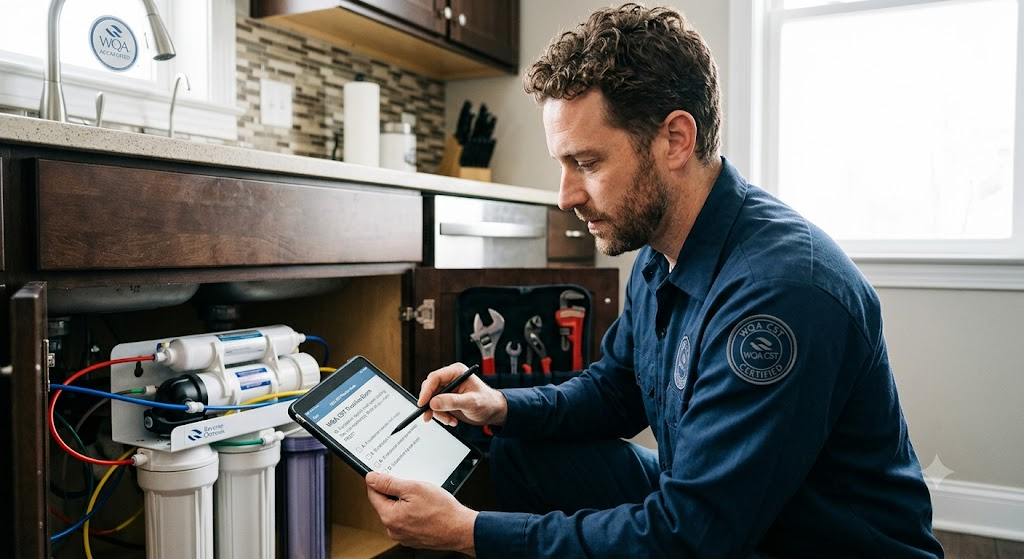
Additional Information
What the Course Entails and Exam Details
Preparing for the WQA CST exam requires a comprehensive understanding of several key domains within the water treatment sector.
The curriculum and the exam blueprint primarily cover the following core areas:
Diagnosis and Troubleshooting: A significant portion of the exam focuses on your ability to evaluate system failures, identify root causes of common water treatment issues, and interpret system diagnostics.
System Repair and Maintenance: You will be tested on standard operating procedures for repairing specific components, including valves, controls, media tanks, and chemical feed pumps.
Water Chemistry and Contaminants: Understanding the properties of water, identifying common contaminants (such as hardness minerals, iron, arsenic, and lead), and knowing the corresponding treatment technologies is essential.
Application and Sizing: While the Certified Water Specialist (CWS) focuses heavily on design, the CST must understand the principles of system application to ensure that existing equipment is sized correctly for the household's water demand and contaminant levels.
Premise Plumbing and Hydraulics: Knowledge of plumbing codes, pipe sizing, flow rates, and pressure management is crucial for safe and efficient service operations.
Safety and Ethics: The exam includes dedicated sections on workplace safety protocols and adherence to the WQA Code of Ethics.
The associated training path typically involves self-paced online modules and extensive study of the WQA Knowledge Base.
What to Expect in the Final Exam
The final Certified Service Technician (CST) exam is a rigorous assessment administered by the WQA.
Candidates should prepare for the following format and regulations:
Exam Format: The test consists of 100 multiple-choice questions designed to evaluate both theoretical knowledge and practical application scenarios.
Time Limit: Candidates are allotted 3 hours to complete the examination.
Passing Score: The exam is scored on a scaled system ranging from 0 to 600, with a minimum passing score of 390 required.
Prerequisites: You must have a minimum of two years of continuous field experience in servicing and troubleshooting POU/POE water treatment systems or have completed the WQA’s dedicated training pathway. Additionally, all candidates must complete the WQA Ethics training before the certification is finalized.
Testing Rules: The exam is closed-book, and candidates must present valid photo identification. No electronic devices are permitted during the session.
How to Study and Exam Centers
Successfully preparing for the CST exam requires a disciplined study plan.
The Water Quality Association provides the primary resources needed for success:
Utilize Official Resources: Your foundation should be the WQA Online Knowledge Base (KB). This vast digital archive contains technical articles, glossaries, and modules specifically tagged for CST preparation.
Take Practice Tests: Dedicated practice exams are invaluable. They not only help you familiarize yourself with the structure and tone of the questions but also expose areas where you need further study. Focus on improving your speed to ensure you can finish within the time limit.
Review the Exam Blueprint: Analyze the WQA CST Exam Blueprint to understand the percentage weight assigned to each topic domain. Prioritize your study time accordingly, focusing heavily on Diagnosis (46%) and Safety (18%).
Exam Centers
The WQA aims to make the testing process as accessible as possible.
Candidates have two primary options for taking the exam:
Online Proctored Testing: Most technicians take the exam remotely through the WQA’s secure online testing portal. This option requires a stable internet connection, a webcam, and a microphone for live proctoring.
Physical Testing Centers: In some instances, the WQA may offer physical testing locations or proctored sessions at industry events, conventions, or through authorized educational partners. You can select your preferred method during the registration process on the WQA website.
Job Opportunities from the Course
Earning your Certified Service Technician designation unlocks numerous advanced career opportunities and demonstrates your readiness for specialized roles in the water quality industry.
This certification is highly valued by employers looking to fill key technical positions.
Potential job titles and career paths include:
Water Treatment Service Technician
Field Service Representative
Senior Service Technician
Technical Support Specialist (Manufacturer)
Service Manager
Installation and Service Coordinator
Independent Water Quality Consultant
Frequently Asked Questions
Reviews
5.0
Based on 0 reviews
Leave a Review
No reviews yet. Be the first to review!