
WSU Veterinary Medicine Admissions Interview Practice Test
$69.00
- Buy to unlock unlimited access to all Quiz questions and Answers in this Quiz.
- After purchase you can print a PDF of the whole quiz at any point. The PDF will contain the questions and the correct answers.
About this Exam
The Washington State University (WSU) Veterinary Medicine Admissions Interview is the crucial final stage in the competitive application process for the Doctor of Veterinary Medicine (DVM) program. This practice test and study guide are meticulously designed for aspiring veterinarians who have submitted their VMCAS application and are preparing to showcase their non-academic strengths to the WSU Admissions Committee. It is designed for candidates who have demonstrated academic excellence and now need to prove their readiness for the emotional, ethical, and interpersonal challenges of the veterinary profession. Our comprehensive prep material focuses on the specific behavioral questions, situational judgments, and understanding of veterinary issues that WSU prioritizes during their selection process.
Ready to test your knowledge?
Buy Now to Access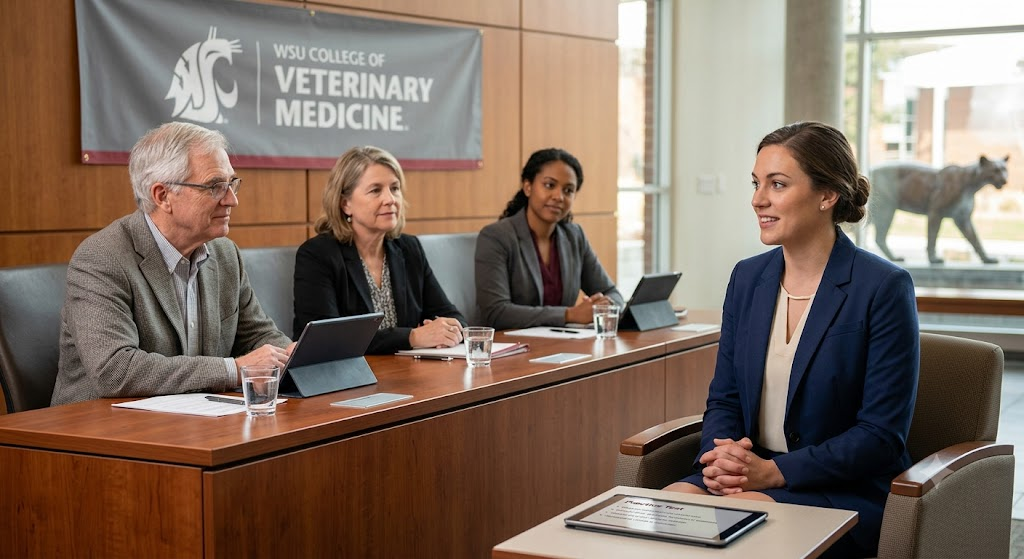
Additional Information
What the Course Entails and Exam Details
Preparing for the WSU Vet Med Admissions Interview entails mastering several core domains that the admissions panel uses to evaluate a candidate’s potential. This practice test program covers essential skills such as advanced communication, emotional intelligence, and ethical decision-making within a veterinary context. Candidates will review modules on the current landscape of the veterinary profession, including challenges in animal welfare, public health, and the economic realities of practice. The course details the expected behavior during traditional panel interview formats, including how to structure answers to behavioral questions using the STAR method (Situation, Task, Action, Result). You will gain experience in analyzing complex scenarios where you must balance the needs of the animal, the wishes of the owner, and the ethical obligations of the veterinarian.
What to Expect in the Final Exam
The actual WSU Veterinary Medicine Admissions Interview is typically structured as a traditional panel interview, rather than a standard multiple-choice test. You can expect to sit before a panel of two to three interviewers, which may include WSU faculty members, practicing veterinarians, and admissions staff, for approximately 30 minutes. The "exam format" here is conversational and behavioral; the panel will ask a series of structured questions designed to explore your maturity, motivation, and knowledge of the profession. While there is no numerical "passing score" requirement in the traditional sense, your performance is evaluated using a rubric that scores your communication clarity, problem-solving reasoning, and empathy. Strict rules include professional dress code, punctuality (usually arriving 30 minutes early in person, or logging on 15 minutes early virtually), and adherence to confidential scenario content if MMIs elements are incorporated in cooperative programs.
How to Study and Exam Centers
Effective study for this interview requires active practice rather than passive reading. We highly recommend engaging in mock interviews with peers, mentors, or veterinary professionals who can provide honest feedback on your delivery, body language, and answer structure. Practice articulating your "Why WSU?" and "Why Veterinary Medicine?" reasons out loud, ensuring they are concise, authentic, and supported by your experiences. Review current trends and ethical dilemmas in the veterinary field by reading reputable veterinary journals or resources like the AVMA (American Veterinary Medical Association) website. The actual WSU interviews are not conducted at Pearson VUE or standard testing centers. They are hosted directly by the WSU College of Veterinary Medicine, often held in Pullman, Washington, or potentially virtually via platforms like Zoom, depending on the current admissions cycle policy. You must receive an official invitation from WSU after your primary application review to schedule and attend your interview.
Job Opportunities from the Course
Successfully navigating the admissions interview opens the door to the DVM program at WSU. Once you obtain your Doctor of Veterinary Medicine degree, you are eligible for a vast range of prestigious and fulfilling career paths. These job opportunities do not arise directly from the practice test itself, but from the DVM degree the interview helps you secure. Potential career paths include: General Practice Veterinarian (Small, Large, or Mixed Animal), Veterinary Specialist (e.g., Surgery, Oncology, Internal Medicine, Cardiology), Public Health Veterinarian (e.g., USDA, CDC, State Veterinarian), Wildlife Veterinarian or Zoo Veterinarian, Shelter Medicine Veterinarian, Research Veterinarian (Academia or Industry), Pharmaceutical Industry Veterinary Liaison, and Military Veterinarian (Army Veterinary Corps). By preparing thoroughly for the WSU Vet Med Admissions Interview, you are taking the definitive final step toward achieving these diverse and rewarding professional goals.
Frequently Asked Questions
Reviews
5.0
Based on 0 reviews
Leave a Review
No reviews yet. Be the first to review!