
WTSDA Red Belt Practice Test
$69.00
- Buy to unlock unlimited access to all Quiz questions and Answers in this Quiz.
- After purchase you can print a PDF of the whole quiz at any point. The PDF will contain the questions and the correct answers.
About this Exam
The World Tang Soo Do Association (WTSDA) Red Belt is a prestigious and rigorous milestone on the journey toward Black Belt mastery. It is designed specifically for highly dedicated Tang Soo Do students who have already achieved advanced proficiency through the Gup (color belt) ranks. In the WTSDA ranking system, the Red Belt usually represents the 3rd Gup, moving up to 1st Gup before testing for Cho Dan (Black Belt). This rank symbolizes maturity, passion, and danger—the maturity of the harvest season, the passion for training, and the danger of the techniques. This certification confirms that a student is no longer a beginner or intermediate practitioner but a martial artist preparing to lead and become a master.
Ready to test your knowledge?
Buy Now to Access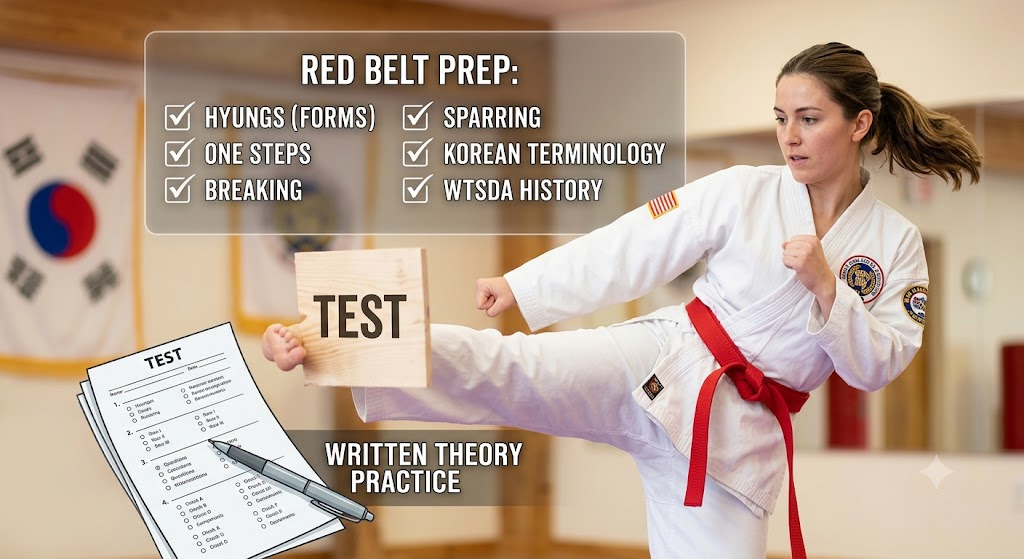
Additional Information
What the Course Entails and Exam Details
Preparing for the WTSDA Red Belt Practice Test requires comprehensive mastery of the advanced Tang Soo Do curriculum. The course of study entails perfecting the full spectrum of practical techniques and deep theoretical knowledge established by the WTSDA. Candidates must demonstrate proficiency in advanced combinations of kicks, blocks, and stances, ensuring they can execute them with speed, power, and precision. You must master the required senior-level Hyungs (Forms)—such as the Pyung Ahn series, and likely the senior-level open-hand forms required by your studio (e.g., Bassai). Furthermore, the test includes complex One-Step Self-Defense (Ho Sin Sul) routines, multiple-board power breaking, and intense sparring sessions where candidates must apply their training under pressure while maintaining courtesy and control. The curriculum also demands a thorough understanding of martial arts philosophy, tenets of Tang Soo Do, and Korean terminology.
What to Expect in the Final Exam
The actual WTSDA Red Belt exam is a comprehensive assessment that tests both physical skill and mental fortitude. Candidates must expect a dual-format examination. First is the practical exam, which is typically conducted in person before a panel of certified WTSDA Masters and senior instructors. This part involves performing all required forms, combinations, one-step defense, sparring, and breaking requirements on demand. Evaluation is based on technical proficiency, proper attitude, focus, speed, power, and the WTSDA philosophy. Second is the theoretical written exam. This part includes multiple-choice questions, true-or-false statements, and short-answer questions. The written test covers Tang Soo Do history, standard Korean terminology for all techniques, the WTSDA tenets (e.g., integrity, perseverance), and the significance of the belt system. Students are required to achieve a high proficiency score—often 80% or higher—to pass both the written and practical components to qualify for promotion.
How to Study and Exam Centers
Effective study for the Red Belt Practice Test requires structured training rather than last-minute cramming. Your primary study strategy should involve consistent, daily physical practice of all your forms and techniques, ideally under the guidance of your instructor. Utilize a study guide—like this practice test summary—to track your physical mastery of the requirements. To prepare for the written component, leverage flashcards for Korean terminology and review your WTSDA student manual diligently. A great study method is to take reputable online practice tests, as these can simulate the written exam format and identify areas where your historical or technical knowledge needs reinforcement. Practice breaking scenarios (visualize your target) and engage in mock sparring to build stamina and situational awareness. Regarding testing locations, the WTSDA exam centers are never standardized testing hubs like Pearson VUE. These specialized martial arts exams are held strictly within certified WTSDA member studios or at regional WTSDA championship events, where only authorized instructors can administer the test and submit results to the World Tang Soo Do Association headquarters for certification.
Job Opportunities from the Course
While a Tang Soo Do Red Belt is primarily a martial arts certification, it represents leadership and advanced training that open distinct pathways in the martial arts community. This rank is a prerequisite for instructor certification.
The career paths this certification unlocks include:
Assistant Martial Arts Instructor
Youth Martial Arts Program Leader
Martial Arts Studio Administrator
WTSDA Leadership Club Member
Advanced Martial Arts Camp Counselor
Pre-cursor to Certified WTSDA Instructor
Frequently Asked Questions
Reviews
5.0
Based on 0 reviews
Leave a Review
No reviews yet. Be the first to review!