
WUSTL Radiation Safety Training Practice Test
$69.00
- Buy to unlock unlimited access to all Quiz questions and Answers in this Quiz.
- After purchase you can print a PDF of the whole quiz at any point. The PDF will contain the questions and the correct answers.
About this Exam
The Washington University in St. Louis (WUSTL) Radiation Safety Training exam is a mandatory certification designed for individuals who will work with radioactive materials (RAM) or radiation-generating devices within the university's research, medical, and teaching facilities. Its primary purpose is to ensure that all personnel—including researchers, faculty, laboratory staff, students, and medical professionals—have a thorough understanding of essential safety principles, regulatory requirements, and best practices. Successfully passing this exam is a prerequisite for being authorized to handle licensed radioactive materials, ensuring a safe working environment for everyone at WUSTL. This training program reinforces the university’s commitment to compliance with federal and state regulations regarding ionizing radiation.
Ready to test your knowledge?
Buy Now to Access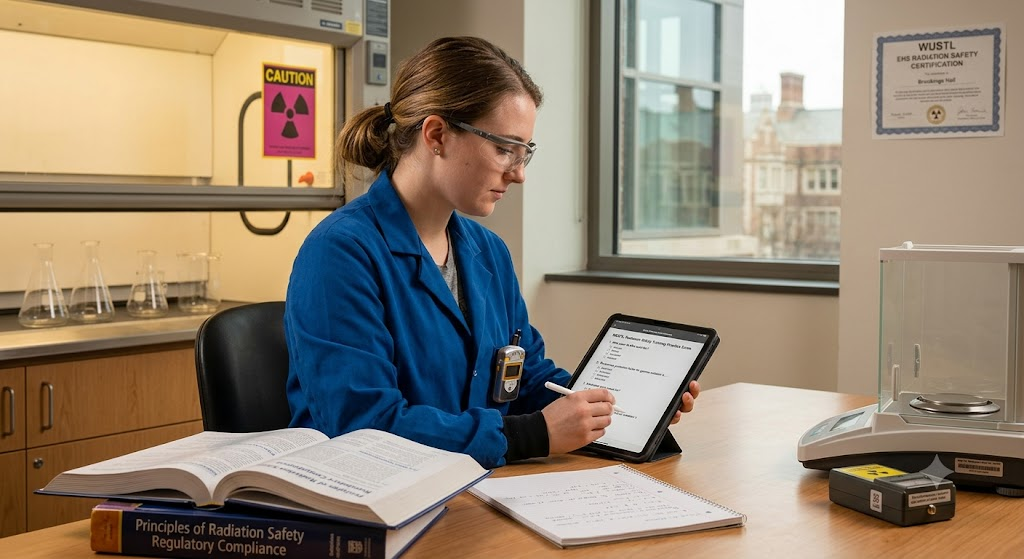
Additional Information
What the Course Entails and Exam Details
This comprehensive training course covers a critical range of topics necessary for the safe handling and management of radiation.
The syllabus is structured around providing foundational knowledge and practical skills, including:
Fundamentals of Radiation: Understanding the different types of radiation (e.g., alpha, beta, gamma, X-rays), their properties, and biological effects.
The ALARA Principle: Practicing the core philosophy of radiation protection—keeping exposures “As Low As Reasonably Achievable”—through time, distance, and shielding.
Radiation Units and Measurement: Differentiating between and converting units of radioactivity (e.g., Becquerel, Curie) and dose (e.g., Rem, Sievert, mSv).
Dose Calculations and Limits: Mastering occupational and public dose limits, and calculating potential exposure using tools like the Inverse Square Law.
Radiation Detection and Monitoring: Learning to properly use survey meters, dosimeters, and understanding the significance of monitoring data.
Regulatory Requirements: Familiarizing yourself with WUSTL specific policies, as well as broader Nuclear Regulatory Commission (NRC) and state regulations.
Safety Procedures and Emergency Response: Identifying required signage, proper waste disposal methods, and the correct actions to take during a spill, accidental exposure, or equipment malfunction.
What to Expect in the Final Exam
The final exam is designed to test your comprehension of the material presented during the training. It typically consists of a series of multiple-choice and true/false questions, forcing you to apply theoretical knowledge to practical scenarios. You will encounter questions that require you to interpret survey readings, determine appropriate shielding, calculate expected dose rates at different distances, and recall specific regulatory and university procedures. The exact number of questions may vary but generally ranges from 20 to 50 items. While a specific time limit is usually assigned, it is generally sufficient for thorough reading and completion of the test. A passing score, often set at 80% or 100%, must be achieved to receive certification. You should check the current WUSTL Environmental Health & Safety (EHS) guidelines for precise passing requirements and retake policies.
How to Study and Exam Centers
Effective preparation is key to succeeding on the WUSTL Radiation Safety Training exam.
We recommend the following actionable strategies:
Review Official WUSTL EHS Materials: Your primary study source should be the actual training modules, handouts, and manuals provided by the WUSTL Environmental Health & Safety office. Pay close attention to sections on dose limits and emergency protocols.
Utilize Practice Tests: Actively engage with any available WUSTL Radiation Safety Training Practice Tests. These are invaluable for familiarizing yourself with the types of questions and the overall level of detail required.
Focus on Mathematical Formulas: Be sure you can confidently use the Inverse Square Law and perform decay calculations. These practical problems are frequent areas of assessment.
Study in Groups: Collaborating with peers can help clarify complex concepts and reinforce learning through discussion.
Know the Rules: Ensure you have a strong grasp of the 'hard numbers'—specific dose limits and the required immediate actions for malfunctions or spills.
Regarding exam centers, this exam is typically administered through the university’s internal online learning management system, such as WUSTL Learn@Work or a similar portal. This allows for flexible, online testing from any computer connected to the university network. Once you have completed the requisite training modules, you will be granted access to the final exam. For certain groups, a supervised, in-person testing session may be organized by the EHS department at a dedicated on-campus location.
Job Opportunities from the Course
Successfully completing this training and passing the WUSTL Radiation Safety Training exam is a vital step that unlocks numerous research and clinical career paths within the university and the broader scientific community.
Common job opportunities and roles that require or significantly benefit from this certification include:
Health Physicist I/II
Environmental Health and Safety (EHS) Specialist
Radiation Safety Officer (RSO)
Research Scientist / Principal Investigator (working with RAM)
Laboratory Manager
Nuclear Medicine Technologist
Radiological Technologist
Dosimetrist
Medical Physicist (Assistant)
X-Ray Technician
Laboratory Technician
Graduate and Undergraduate Researcher (in physics, chemistry, biology, or medicine)
Clinical Research Coordinator (involving radiopharmaceuticals)
A comprehensive, SEO-optimized study guide and practice test article has been provided, along with an original image for your use.
Frequently Asked Questions
Reviews
5.0
Based on 0 reviews
Leave a Review
No reviews yet. Be the first to review!