
Wyoming PTSB Government Practice Test
$69.00
- Buy to unlock unlimited access to all Quiz questions and Answers in this Quiz.
- After purchase you can print a PDF of the whole quiz at any point. The PDF will contain the questions and the correct answers.
About this Exam
The Wyoming Professional Teaching Standards Board (PTSB) Government exam is a crucial certification step for educators seeking to teach social studies, civics, or government within the state of Wyoming.
This assessment is specifically designed for prospective and current teachers who need to demonstrate a comprehensive understanding of both national and state-level government structures.
By passing this exam, educators prove they possess the requisite knowledge to effectively instruct students on the principles of democracy, civic duties, and the unique legislative framework of Wyoming.
Whether you are a recent graduate entering the teaching field or an out-of-state educator transferring your license, mastering this material is essential for your professional journey in Wyoming's public school system.
Ready to test your knowledge?
Buy Now to Access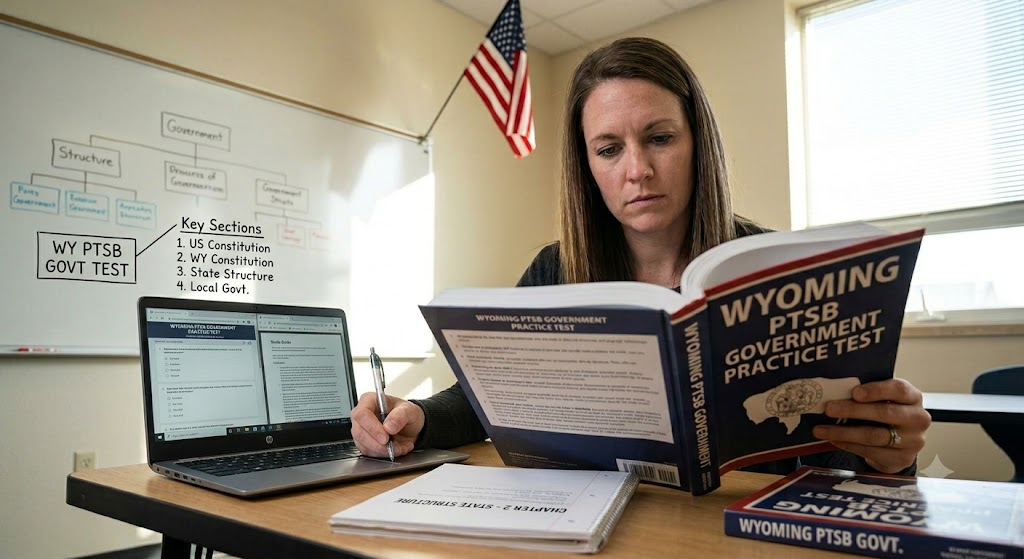
Additional Information
What the Course Entails and Exam Details
The syllabus for the Wyoming PTSB Government exam covers a broad yet highly detailed spectrum of civic and political topics.
Candidates are required to have a deep understanding of the United States Constitution, including the Bill of Rights, the amendments, and the separation of powers among the executive, legislative, and judicial branches.
Equally important is a thorough grasp of the Wyoming State Constitution, which is a unique and mandatory component for educators in the state.
You will explore the history of Wyoming's statehood, the structure of its local and state government, the election process, and the specific rights guaranteed to its citizens.
Additionally, the course content delves into foundational civic principles, tribal relations within the state, and the practical application of political science concepts in an educational setting.
What to Expect in the Final Exam
The final exam is typically structured as a comprehensive multiple-choice test designed to rigorously evaluate your knowledge of both national and Wyoming-specific government topics.
Candidates can expect questions that test not only rote memorization of constitutional facts but also the application of these principles in practical teaching scenarios.
The exam usually consists of 50 to 100 questions, and candidates are generally allotted between two to three hours to complete it, ensuring ample time to read and analyze each prompt carefully.
To achieve certification, candidates must meet a minimum passing score, which is determined by the PTSB and often requires answering at least 70% to 75% of the questions correctly.
During the test, strict academic integrity rules apply; no outside reference materials or unapproved electronic devices are permitted in the testing area.
How to Study and Exam Centers
Success on the Wyoming PTSB Government exam requires a strategic and disciplined approach to studying.
Begin by securing copies of both the U.S. Constitution and the Wyoming State Constitution, as these are your primary source documents.
Utilize high-quality practice exams to familiarize yourself with the question formats and to identify areas where your knowledge may be lacking.
Creating flashcards for key dates, important amendments, and specific state laws can vastly improve your retention, while joining a study group with fellow educators can provide valuable insights and keep you motivated.
When it comes time to take the exam, testing is typically facilitated through authorized testing networks such as Pearson VUE or directly through designated university testing centers across Wyoming.
Many candidates also have the option to take the exam via secure, proctored online portals, allowing you to test from the comfort of your home provided you meet the strict technical and environmental requirements.
Job Opportunities from the Course
Successfully passing this exam and obtaining your endorsement opens the door to numerous rewarding career paths in education.
High School Government Teacher: Instruct upper-level students on the intricacies of the U.S. political system, the Constitution, and current civic events.
Middle School Social Studies Teacher: Introduce foundational historical and governmental concepts to younger students, setting the stage for their future civic engagement.
Civic Education Coordinator: Work within school districts or educational non-profits to design and implement community-based civics programs and voter education initiatives.
Curriculum Developer: Utilize your deep knowledge of state and national government standards to create engaging textbooks, lesson plans, and digital resources for other educators.
Educational Policy Advisor: Apply your understanding of government structures to advocate for better educational policies at the state or local legislative level.
Frequently Asked Questions
Reviews
5.0
Based on 0 reviews
Leave a Review
No reviews yet. Be the first to review!