
Xray Positioning Practice Test
$69.00
- Buy to unlock unlimited access to all Quiz questions and Answers in this Quiz.
- After purchase you can print a PDF of the whole quiz at any point. The PDF will contain the questions and the correct answers.
About this Exam
Welcome to your essential resource for mastering the Xray Positioning Practice Test. This comprehensive guide is specifically designed for aspiring radiologic technologists, X-ray technicians in training, and any healthcare professional seeking to perfect their ability to position patients accurately for diagnostic imaging. A deep understanding of radiographic positioning is not just a theoretical requirement; it is the cornerstone of generating high-quality diagnostic images while ensuring patient comfort and safety. This practice test serves as a crucial milestone, allowing you to simulate the pressure of an examination and build the procedural confidence required for clinical success.
Ready to test your knowledge?
Buy Now to Access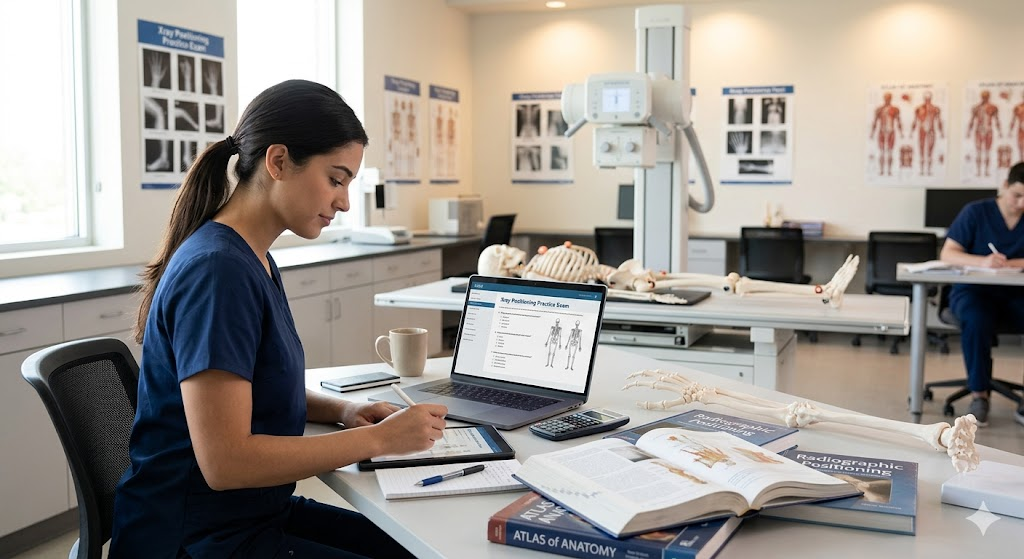
Additional Information
What the Course Entails and Exam Details
This examination is an in-depth assessment of your practical, hands-on knowledge regarding the positioning of patients for a comprehensive range of X-ray procedures. It goes beyond simple identification, testing your ability to adapt techniques to diverse patient body types and clinical scenarios. The core syllabus encompasses:
Terminology and Principles: Master anatomical directions, planes, and movement terms.
Skeletal System (Extremities): Expert positioning for all upper and lower limbs, including trauma adaptations.
Axial Skeleton: In-depth coverage of the skull, facial bones, and all sections of the vertebral column.
Thorax and Abdomen: Precision techniques for chest, bony thorax, and abdominal radiography.
Fluoroscopic and Contrast Studies: Foundations for gastrointestinal, genitourinary, and other specialized procedures.
Image Evaluation: Your ability to critique and recognize a properly positioned radiograph for diagnostic criteria.
The specific "Xray Positioning Practice Test" is typically offered as part of a radiography educational program, a dedicated certification prep course, or through reputable online learning platforms. It is rarely a standalone national board exam but is an indispensable tool to prepare for comprehensive licensure.
What to Expect in the Final Exam
While formats vary, this practice test is expertly designed to mirror the structure and complexity of major certification exams, such as the Procedures section of the ARRT (American Registry of Radiologic Technologists) Radiography examination. You should expect:
Format: Primarily multiple-choice questions. A significant number of questions will be scenario-based or incorporate radiographic images, diagrams, or clinical photos, requiring you to select the correct position, central ray angle, or image evaluation criteria.
Question Types: You may encounter image identification (e.g., "Which position does this image demonstrate?"), procedural adaptation ("How would you modify positioning for a patient with a suspected trauma to the spine?"), and safety-based questions.
Time Limit: Expect a timed format to test your mental speed and procedural recall under pressure.
Passing Score: A passing score varies by provider, but usually, a score of 75% to 80% is recommended to indicate a readiness for the actual national certification exam.
The actual final certification exam (e.g., ARRT) is a much longer, comprehensive assessment covering all domains of radiography, taken at a formal proctored testing center. Your success on this practice test is a direct indicator of your preparedness for this crucial section.
How to Study and Exam Centers
Preparation for positioning requires a dual approach that combines theoretical knowledge with practical application. Here are your actionable study strategies:
Practice, Practice, Practice: The single most effective method is active repetition in a radiography lab or clinical setting. Utilize peers or anatomical models to simulate positioning for every standard projection until it becomes muscle memory.
Visual Atlases: Invest in a comprehensive radiographic positioning atlas, such as "Bontrager's Textbook of Radiographic Positioning and Related Anatomy," and memorize the visual criteria for every projection.
Utilize Practice Banks: Re-take the "Xray Positioning Practice Test" multiple times. Focus on understanding the rationales for both correct and incorrect answers, not just memorizing.
Peer-to-Peer Teaching: Explain a position and its corresponding evaluation criteria to a fellow student. Teaching is a powerful reinforcement tool.
Exam Centers: Since this is a practice test, you will typically access it through an online learning management system (LMS) or portal provided by your school, a certification prep service, or an authorized training provider. It is not generally taken at a physical proctored center like Pearson VUE.
Job Opportunities from the Course
Mastering the knowledge assessed in this Xray Positioning Practice Test is the vital foundation required to launch a rewarding career in medical imaging. Successfully passing this level of assessment paves the way toward multiple specialized job titles and career paths:
Radiologic Technologist (R.T.)
General X-ray Technician
Computed Tomography (CT) Technologist
Magnetic Resonance Imaging (MRI) Technologist
Mammography Technologist
Interventional Radiography Technologist
Bone Densitometry (BD) Technologist
Your dedication to perfecting patient positioning through this practice exam is the first definitive step towards building a successful and essential career in diagnostic medical imaging.
Frequently Asked Questions
Reviews
5.0
Based on 0 reviews
Leave a Review
No reviews yet. Be the first to review!