
YMCA Basic Life Support (BLS) Training Practice Test
$69.00
- Buy to unlock unlimited access to all Quiz questions and Answers in this Quiz.
- After purchase you can print a PDF of the whole quiz at any point. The PDF will contain the questions and the correct answers.
About this Exam
The YMCA Basic Life Support certification is a crucial, life-saving credential designed for professionals who need advanced training in responding to cardiac and breathing emergencies.
This exam targets individuals who are expected to provide high-quality CPR and critical care in a structured, team-oriented environment.
Whether you are a lifeguard, a fitness instructor, a medical professional, or a dedicated childcare provider, this certification proves you have the essential skills needed to act decisively during sudden medical crises.
Preparing for the practice test is your first step toward mastering these life-saving techniques and gaining the confidence to handle high-pressure emergency situations.
Ready to test your knowledge?
Buy Now to Access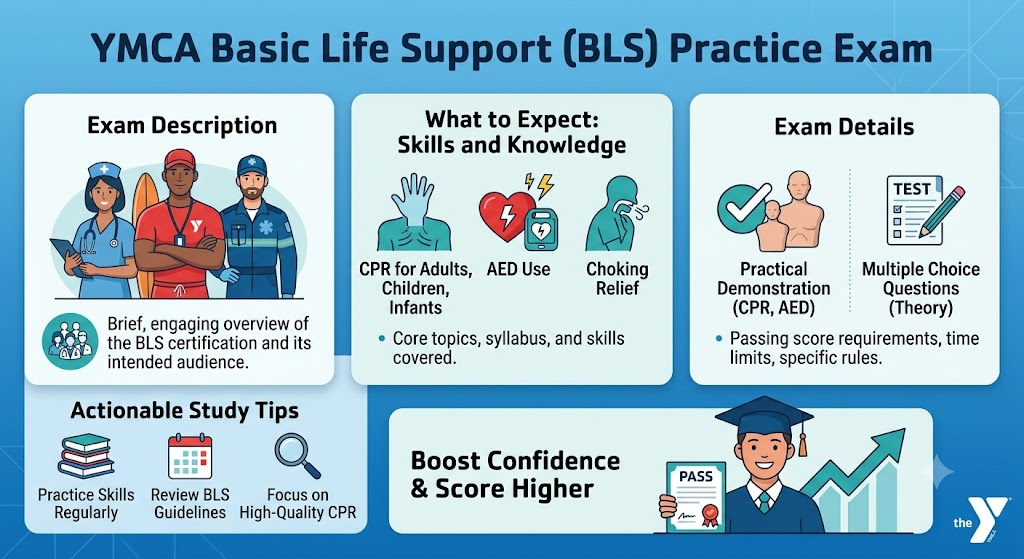
Additional Information
What the Course Entails and Exam Details
The core syllabus of the YMCA BLS program focuses extensively on prompt recognition of life-threatening emergencies and immediate, effective intervention.
You will dive deep into the mechanics of high-quality cardiopulmonary resuscitation (CPR) for adults, children, and infants.
The course covers the critical usage of an Automated External Defibrillator (AED) and how to seamlessly integrate it into your CPR cycle.
Additionally, you will learn the precise techniques for relieving foreign-body airway obstructions, commonly known as choking, across all age groups.
A major focus of the training is on team dynamics, teaching you how to communicate effectively and divide responsibilities when multiple rescuers are present.
What to Expect in the Final Exam
The final evaluation is comprehensively designed to test both your theoretical knowledge and your muscle memory in practical applications.
You can expect a two-part assessment consisting of a written multiple-choice exam and a hands-on skills demonstration.
The written exam typically features between 25 and 50 questions, assessing your understanding of the steps in the chain of survival, appropriate compression depths, and rescue breathing ratios.
To pass, most testing guidelines require a minimum score of 80% or higher on the written portion.
During the practical assessment, an instructor will observe you performing CPR and using an AED on adult and infant manikins, ensuring you meet strict timing and technique standards without assistance.
How to Study and Exam Centers
Your primary study strategy should involve a careful review of the official BLS provider manual, paying special attention to the algorithm charts for single and multi-rescuer responses.
Taking multiple practice exams is highly recommended to familiarize yourself with the phrasing of the multiple-choice questions and to improve your testing speed.
For the practical portion, muscle memory is key, so take full advantage of any open practice sessions your instructor offers with the training manikins.
When it comes to taking the final exam, the practical skills test must be completed in person at an authorized physical testing center, which usually includes local YMCA branches or affiliated community centers.
Some theoretical portions may be offered via online portals if you are enrolled in a blended learning format, but the final certification always requires an in-person skills checkoff by a certified instructor.
Job Opportunities from the Course
Achieving your BLS certification opens the door to numerous fulfilling and vital career paths.
Certified Lifeguard
Aquatics Director
Fitness Center Manager
Personal Trainer
Group Exercise Instructor
Emergency Medical Technician (EMT) Candidate
Medical Assistant
Childcare Center Director
Camp Counselor
Rehabilitation Specialist
Frequently Asked Questions
Reviews
5.0
Based on 0 reviews
Leave a Review
No reviews yet. Be the first to review!