
Youth Court Bar Practice Exam
$69.00
- Buy to unlock unlimited access to all Quiz questions and Answers in this Quiz.
- After purchase you can print a PDF of the whole quiz at any point. The PDF will contain the questions and the correct answers.
About this Exam
The Youth Court Bar Practice Exam is a rigorous educational certification designed for high school and early college students wishing to participate as student attorneys within localized Youth Court (or Teen Court) diversionary programs.
These programs offer an alternative to the traditional juvenile justice system, allowing young people who have committed minor offenses to be judged by their peers. The certification ensures that student advocates possess the necessary knowledge of restorative justice, basic legal procedure, and ethical responsibility required to represent their peers fairly.
This exam is perfect for students aspiring to careers in law, public service, social work, or criminology, providing a unique, hands-on foundation in the principles of advocacy and civic duty.
Ready to test your knowledge?
Buy Now to Access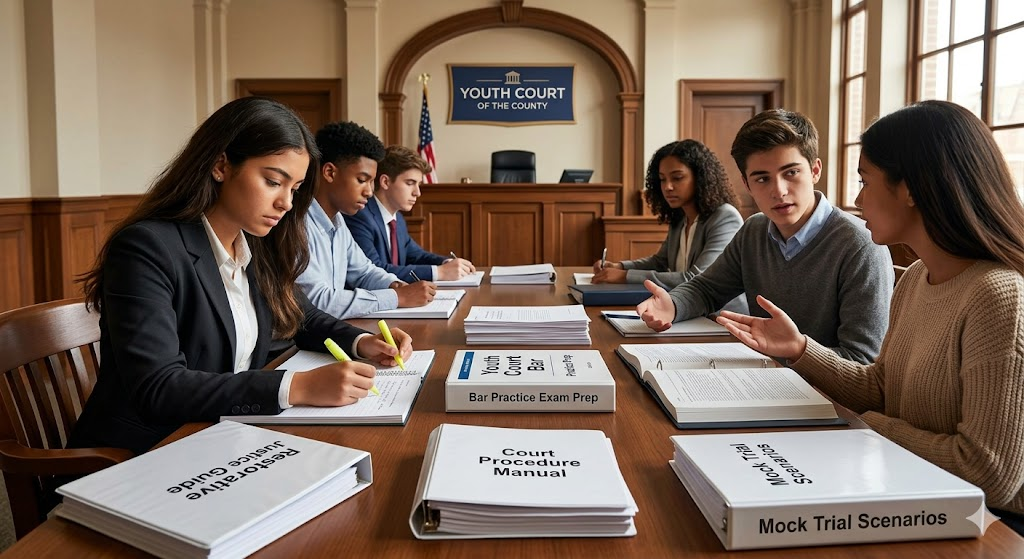
Additional Information
What the Course Entails and Exam Details
Preparing for this certification involves mastering a specialized curriculum that bridges legal knowledge with social responsibility. While specific syllabi vary by jurisdiction, the core topics typically covered include:
Principles of Restorative Justice: Understanding the philosophy of repairing harm rather than focusing solely on punishment.
Youth Court Structure and Roles: Mastering the duties of the judge, jury, prosecution, defense, and bailiff within the peer court model.
Juvenile Law Basics: A foundational understanding of the localized laws and regulations governing minor offenses and diversion eligibility.
Courtroom Procedure: Knowing the flow of a hearing, from opening statements to sentencing recommendations and closing arguments.
Rules of Evidence (Simplified): Learning how to present facts, object appropriately, and distinguish between relevant and prejudicial information.
Ethics and Confidentiality: The paramount importance of protecting the privacy of the respondent and maintaining professional conduct.
Advocacy Skills: Techniques for effective public speaking, logical argument construction, and witness examination.
What to Expect in the Final Exam
The final certification exam is designed to test both theoretical knowledge and practical application. Candidates should prepare for a multi-component assessment:
Section I: Written Knowledge
Format: Multiple Choice, True/False, and Short Answer questions.
Content: This section assesses memory and understanding of restorative justice principles, legal terminology, ethical codes, and standardized courtroom procedures.
Section II: Practical Advocacy (Mock Hearing)
Format: A performance-based simulation.
Content: Candidates are often required to act in a designated role (either prosecution or defense) in a mock youth court hearing based on a provided case scenario.
Assessment: Evaluators judge candidates on their ability to construct a coherent argument, examine witnesses professionally, adhere to procedure, and deliver compelling opening and closing remarks.
Passing Score Requirements
Because of the serious nature of representing peers, passing scores are typically high, often requiring 80% or higher on the written section and a "Proficient" rating on the practical component.
Time Limits
The written exam usually lasts between 60 to 90 minutes. The practical mock hearing component typically runs for 30 to 45 minutes per candidate.
How to Study and Exam Centers
Actionable Study Strategies
Success on the Youth Court Bar Practice Exam requires a balanced approach to studying:
Thoroughly Review Program Handbooks: Your local Youth Court will provide a manual or handbook. This is your primary textbook. Know it cover-to-cover.
Master Ethics Early: Confidentiality rules are non-negotiable. Memorize these first and understand their application in real-world scenarios.
Practice Mock Trials: The practical section is often the most challenging. Assemble a team of peers to practice mock hearings. Rotate roles to understand all perspectives of the courtroom.
Observe Real Hearings: If permitted, attend actual Youth Court sessions. Observe experienced student attorneys to learn their techniques and how they handle objections or sentencing.
Flashcards for Terminology: Use flashcards to master legal terms, components of restorative justice, and mandatory procedural steps.
Seek Mentorship: Don't hesitate to ask local volunteer attorneys or program coordinators for feedback on your advocacy style or reasoning.
Exam Centers
Because Youth Courts are localized, authorized exam centers are decentralized. You will not take this exam at standardized centers like Pearson VUE.
You will typically take the exam at:
Your local Youth Court program office.
Designated rooms within partnering high schools or colleges.
A localized community center or courthouse authorized by the program.
Some programs may offer the written component through a secure online portal controlled by the local youth justice agency.
Job Opportunities from the Course
While this certification does not grant a license to practice law in adult courts, it is a prestigious credential that unlocks significant educational and early career paths:
Youth Court Student Attorney (Volunteer position within the program)
Teen Court Lead Advocate (Peer leadership role)
Pre-Law Academic Track Placement
Legal Internship Coordinator (Early public service)
Juvenile Justice Program Assistant (Volunteer or stipend role)
Community Mediation Trainee
Social Justice Advocacy Intern
Paralegal Studies Candidate
Frequently Asked Questions
Reviews
5.0
Based on 0 reviews
Leave a Review
No reviews yet. Be the first to review!